
Aftermarket projector headlights are judged fast—and harshly.
Your customers don’t care how many components are inside. They care about three moments: the first night drive, the first rainy week, and the first long highway run. If any of those moments feels wrong, the product quickly becomes “that headlight that causes problems,” and the support burden lands on the distributor, the shop, and the brand.
From our factory side, we’ve learned a simple truth: in the aftermarket, you don’t win by being “bright.” You win by being consistent. Consistent beam behavior, consistent sealing, consistent thermal performance, and consistent left/right matching—across shipments, not just across samples.
Below is what we believe B2B customers should expect from a serious aftermarket projector headlight factory, and what we focus on in production to make reorders feel the same as the first batch.
1) Aftermarket Projector Headlights: What “Good” Means (Calm Light, Not Just Strong Light)
A lot of aftermarket complaints are not electrical failures. They’re comfort failures:
- the cutoff looks sharp but feels “tilted” on the road
- one side looks slightly different from the other
- the beam is bright close to the car but weak downrange
- output feels softer after 20–30 minutes
- condensation shows up and customers stop trusting the product
So when you evaluate aftermarket projector headlights, don’t ask only “how bright is it?” Ask:
- Is the beam stable and repeatable?
- Will the next shipment behave the same?
- Will installers spend time selling it—or defending it?
That’s the commercial definition of quality in aftermarket.
2) Beam Behavior: The Factory’s Job Is to Prevent “Looks Good in Photos, Feels Wrong on Roads”
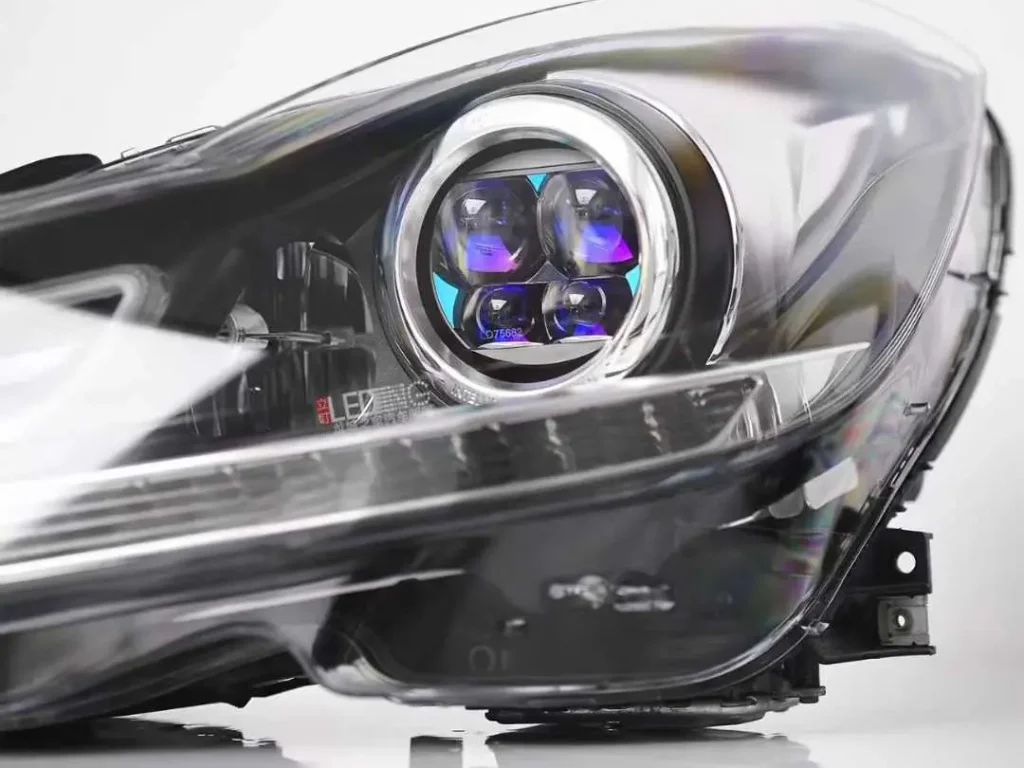
Projectors can create beautiful wall shots. But road comfort depends on details that are easy to lose in production if the factory treats assembly like a cosmetic task.
What we control to keep beam behavior repeatable
- Projector alignment repeatability
Tiny rotational drift becomes visible as cutoff tilt and asymmetric “feel.” - Stray light control
A beam can be sharp and still produce glare if internal reflections are not managed. - Left/right matching discipline
Customers accept “bright.” They don’t accept “different.”
A clean aftermarket beam should feel wide, even, and calm—not like a spotlight that forces the driver’s eyes to constantly adapt.
3) Thermal Stability: Long Drives Reveal What Short Tests Hide
Many problems don’t show up during a quick function check.
After 20–30 minutes of sustained use, heat can change how the system behaves. In the aftermarket, that becomes an argument, because the product still “works,” but the customer feels a difference.
What stable thermal behavior means in real life
- output doesn’t noticeably sag after heat soak
- color doesn’t shift into an odd tint
- beam pattern doesn’t develop artifacts as parts expand
- materials and adhesives don’t soften into long-term drift
For B2B programs, thermal stability is not a premium feature. It’s what keeps your installer network from doing diagnosis for free.
4) Sealing: One Fogging Photo Can Outsell Your Whole Marketing Team (In a Bad Way)
Condensation complaints move faster than technical explanations.
In real distribution markets, one shop posts a fogged lens photo, and suddenly the product becomes “high risk,” even if the root cause is a single weak batch or poor handling.
From the factory perspective, sealing must be designed for repeatable execution:
- sealant channel geometry that supports consistent application
- controlled compression so the seam closes evenly
- venting strategy that behaves consistently across climates
A headlight that survives a factory inspection but fails in a wet season is not “unlucky.” It’s under-designed for aftermarket reality.
5) Case #1 — “Same SKU, Different Beam”: When a Small Assembly Drift Becomes a Sales Problem
What the distributor reported:
“The first shipment was great. The second shipment looks more intense in the center, but installers say the beam feels narrower and a few units look slightly tilted.”
Nothing was dead. But the market reaction was immediate: installers hesitate, reviews become mixed, and your support team starts collecting videos of wall shots.
What we found:
The optical design was unchanged. The drift came from projector orientation repeatability during assembly. Over time, fixture wear and operator “helping by feel” introduced small rotational differences.
Why it mattered:
Even a small rotation doesn’t just tilt a cutoff. It changes perceived width and hotspot position, and that can make a beam feel “aggressive” or glary even when it looks sharp.
What we changed:
We improved the mechanical locating reference, restored fixture discipline, and added a quick orientation verification step that technicians can’t “interpret.”
What you should take from this (as a buyer):
When you see “same model, different beam,” it’s often not a secret component swap. It’s process drift—and a factory that understands aftermarket will treat beam behavior as a controlled output, not a lucky result.
6) Case #2 — “Great on Day One, Softer on Long Drives”: Heat Soak Drift That Causes Quiet Returns
What installers heard from end users:
“It’s bright, but on longer night drives it feels less effective.”
No warning lights. No obvious failure. Just a comfort drop.
What we found:
The root cause was not dramatic part failure. It was a thermal bottleneck and minor variability in thermal contact during assembly. Two units could look identical in a short check, then diverge after sustained operation.
What we changed:
We improved thermal transfer repeatability (the unglamorous part) and tightened assembly control so long-run behavior is less sensitive to technician variability.
What you should take from this (as a buyer):
If your market includes hot climates or long-distance night driving, a product must be evaluated as a system over time, not a “first 60 seconds” impression.
7) What You Can Ask From a Factory (That Actually Helps You Sell and Support)
You don’t need an engineering lab to source well. You need a few practical proofs that reduce future arguments.
Factory-facing requests that are fair and useful
- Controlled beam photos (same distance, same exposure): shows cutoff discipline and obvious scatter
- Left/right matching approach (how we prevent mismatch): reduces “one side feels different” complaints
- Thermal behavior statement (what is designed to hold after sustained use): reduces long-drive disputes
- Sealing repeatability explanation (how sealing is made consistent in production): reduces fogging risk perception
These are not “audit demands.” They’re communication tools that help your sales team promise what the product can reliably deliver.
Closing: Aftermarket Success Is When Reorders Feel Boring
The best aftermarket projector headlight program is the one that becomes boring—in a good way. Installers stop debating beam feel. Your team stops spending nights on complaint videos. Reorders become routine because the product behaves the same shipment after shipment.
That’s what we build toward as a factory: repeatable road behavior, not one impressive sample.
 English
  Español
  Tiếng Việt
  ไทย
ไทย  العربية
  Русский
  Bahasa Melayu
  Français
  Deutsch
  हिन्दी
  Bahasa Indonesia