
DRL vs Headlights vs Tail Lights: Why You Look “Invisible” From Behind in Rain
On a gray rainy afternoon, traffic feels calm—until it doesn’t. The road is shiny, spray hangs in the air, and cars appear and disappear in the mirrors like they’re being edited in and out.
Here’s an uncomfortable truth: a chunk of those “sudden appearances” happen because cars are driving with front lights on and rear lights underlit or off. And the driver often has no idea.
This is the modern lighting trap. Daytime running lights (DRLs) make the front of the car look active. Dash screens stay bright. AUTO mode delays lights because it’s “still daytime.” Meanwhile, the back of the car can be a dark shape in a wet gray world.
This article is not about fog lights. It’s about something more basic—and more common: making sure your rear lights are actually on when weather kills contrast.
The quick version: what each light is supposed to do
DRLs (Daytime Running Lights)
Designed to help others notice you from the front in daytime. DRLs are not a promise that your tail lights are on.
Headlights (low beams)
Designed to light the road ahead and reduce glare compared to high beams. Low beams often trigger full rear lighting as part of the “night driving” state.
Tail lights
Designed to make you recognizable from behind, helping other drivers judge distance and closing speed—especially in rain spray, haze, and dusk.
If your front looks “lit” but your rear is dim, you’ve solved only half the visibility problem.
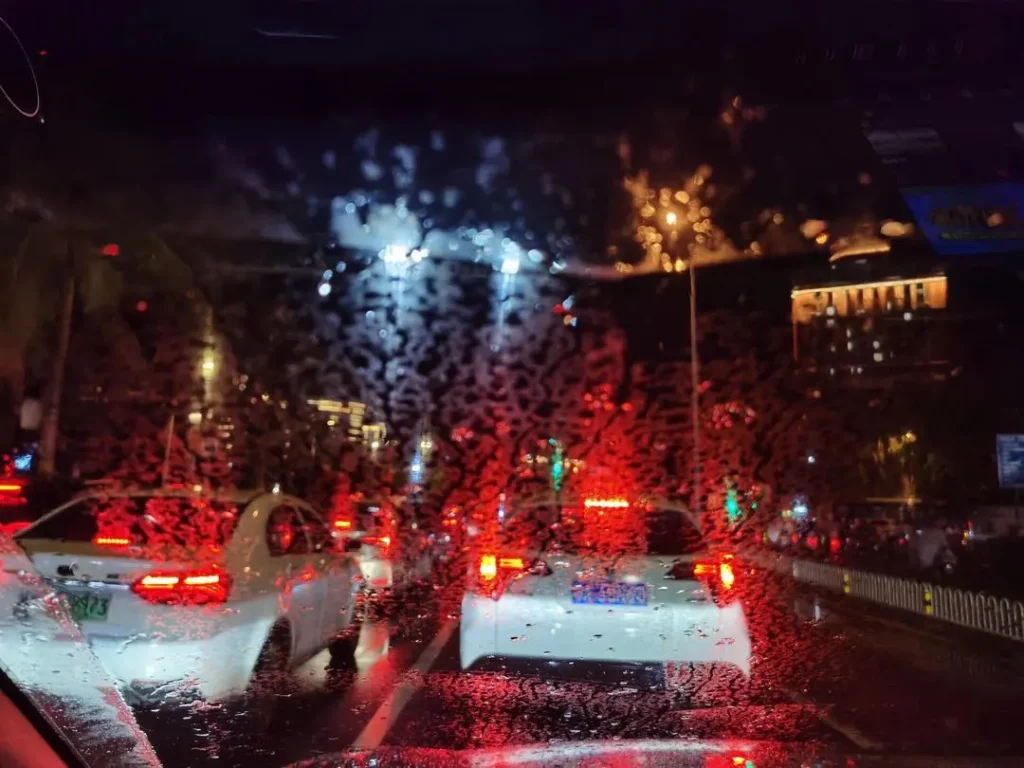
Why DRLs fool normal people (not just careless drivers)
DRLs create a convincing illusion:
- you see light reflecting off road signs
- the car in front looks brighter
- your dashboard is fully lit
- your brain concludes: “lights are on”
But many cars are designed so DRLs do not automatically enable full rear tail lights. Some do. Some don’t. Some behave differently by market.
The key point: you can’t safely guess.
AUTO mode is not “bad weather mode”
AUTO headlights are usually driven by ambient light sensors. That means:
- bright fog can look “bright enough”
- heavy rain can look “bright enough”
- dawn haze can look “bright enough”
The sensor isn’t judging how far you can see. It’s judging how much light is hitting a sensor.
So AUTO mode can fail you in exactly the conditions where tail lights matter most: not midnight darkness, but low-contrast daylight.
The dashboard brightness trap (the reason this mistake is exploding)
Older cars gave you a helpful clue: the dashboard dimmed until headlights were on. Many modern cars don’t work that way. Screens are designed to be readable all the time.
So drivers get:
- a bright cabin
- DRLs in front
- and zero urgency to check anything else
The result: lots of “invisible from behind” cars on rainy highways.
How to confirm your tail lights are on (without special tools)
You don’t need a mechanic. You need a habit.
Method 1: The glass reflection check
In a parking lot, pull up near a storefront window or reflective surface. Cycle your lights:
- OFF/DRL
- Parking lights
- Low beams
Look at the rear reflection. You’ll learn more in 20 seconds than in an hour of arguing online.
Method 2: The “license plate light” hint
On many cars, when low beams are on, the license plate lights are also on. It’s not universal, but it’s a useful clue.
Method 3: The walk-around at fuel stops
In bad weather, do a ten-second loop when you stop for fuel:
- tail lights on?
- brake lights normal?
- one side out?
- plate lights on?
It’s boring. It prevents the kind of near-miss that feels like “bad luck.”
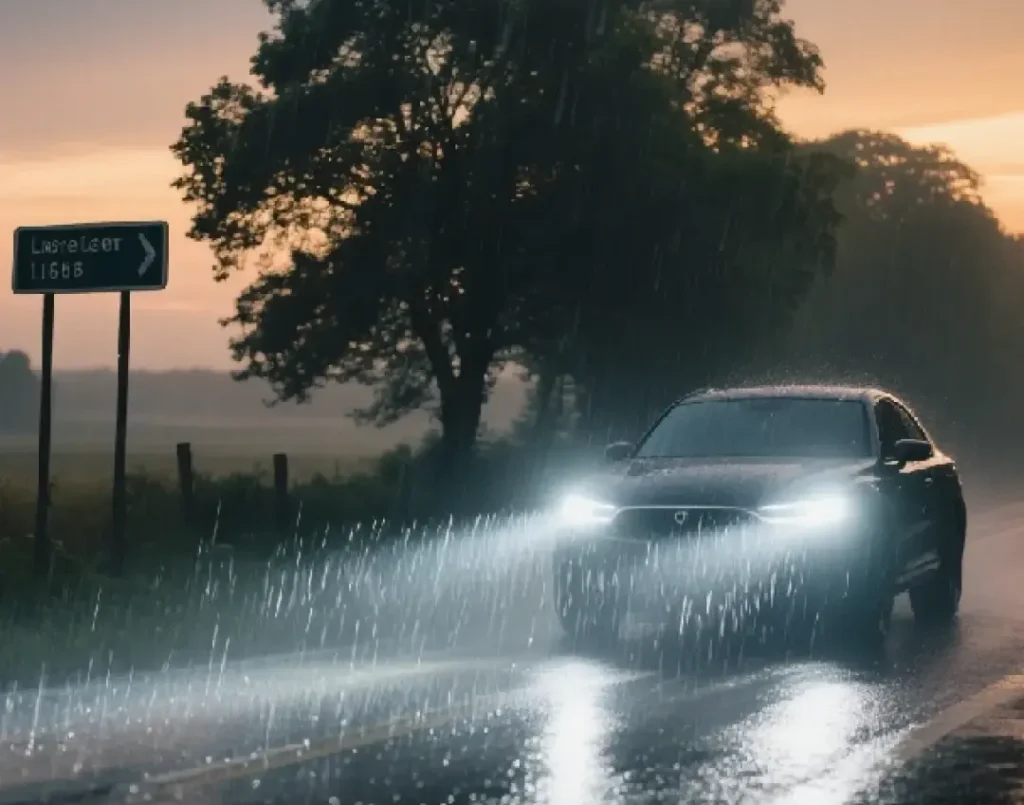
The best habit: wipers on, low beams on
A simple rule used by experienced drivers is:
If the wipers are running continuously, turn on low beams.
Why it works:
- rain and spray reduce contrast long before it gets “dark”
- low beams usually bring full rear lighting online
- it makes you easier to track from behind in spray
Some areas even require it by law. Even where it’s not required, it’s a high-payoff habit.
Why this matters most on highways (spray is basically moving fog)
On highways, the biggest visibility issue isn’t the rain itself. It’s the spray cloud thrown by vehicles, especially larger ones.
In spray:
- car shape disappears
- distances compress
- closing speed feels slower than it is
- tail lights become the primary “this is a vehicle at this distance” cue
If your rear lighting is off or weak, you’re forcing the driver behind you to detect your car by silhouette—exactly when silhouette is hardest to see.
“But my DRLs are bright—people can see me”
From the front, maybe. From behind, maybe not.
Rear-end collisions in low visibility often happen because the driver behind:
- recognizes the car late
- reacts late
- brakes hard
- triggers chain braking
Proper tail lighting doesn’t replace safe speed, but it buys time. Time is what low visibility steals.
Parking lights as a compromise? Usually not the best choice
Some drivers use parking lights instead of low beams to “avoid glare.” The issue is:
- parking lights may not provide meaningful forward illumination
- legality varies
- rear brightness and behavior vary by vehicle
In real-world bad weather, low beams are the safer default. If you’re sensitive to glare, the solution is usually clean glass and correct wiper performance—not running underpowered exterior lighting.
Common situations where drivers mistakenly run DRL-only
1) Daytime fog
It can be bright and still dangerously low visibility. AUTO doesn’t always trigger. DRL-only cars look like shadows from behind.
2) Rainy afternoons
The world is bright enough to fool sensors, but contrast is poor. Rear visibility suffers.
3) Dusk plus rain
This is the worst combination: glare, reflections, and delayed light activation.
4) Tunnels and shaded highways
Some AUTO systems react slowly. Manual low beams solve it instantly.
FAQ
Do DRLs include tail lights?
Sometimes yes, often no. It depends on the vehicle, market, and lighting design. Confirm on your own car—don’t assume.
Why do so many cars have no rear lights in rain?
Because drivers see DRLs and a bright dashboard and assume headlights/tail lights are fully on. Modern cabins removed the old “dash dim = lights off” warning.
If I turn on low beams, does that always turn on tail lights?
On most cars it does. Not all. That’s why the reflection check is so valuable.
 English
  Español
  Tiếng Việt
  ไทย
ไทย  العربية
  Русский
  Bahasa Melayu
  Français
  Deutsch
  हिन्दी
  Bahasa Indonesia