
Most issues around Auto-Grillleuchten aren’t caused by the LEDs. They’re caused by expectations.
A customer buys a set of led grill leuchten thinking they’re a simple styling upgrade. Then they’re surprised by one of these realities:
- certain colors or flashing modes can be restricted where they live
- placement and brightness can attract unwanted attention
- “Off-road use” isn’t a blanket pass for every street and situation.
- the product page implied one thing, the local rules implied another
If you sell, install, or even just recommend grill lights, the safest path is not pretending laws don’t exist. It’s building your messaging so customers can make informed decisions—and so your brand isn’t the one that “promised legal everywhere.”
This article avoids wiring and troubleshooting. It focuses on compliance-minded communication: how to describe grill lights responsibly, what to avoid saying, and how to reduce misunderstandings through clear product pages and support scripts.
Note: I’m not an attorney, and nothing here should be taken as legal advice. Requirements can differ by country, by state/province, and sometimes even by municipality. The goal here is practical risk reduction and clearer customer communication.
Why This Matters (Even If You Don’t Want to Talk About Laws)
If you’re a shop or a brand, compliance isn’t just a legal topic—it’s a customer experience topic.
Poor compliance messaging causes:
- avoidable returns (“I didn’t know amber/flash was restricted”)
- disputes (“your listing said street legal”)
- bad reviews (“got pulled over because of these”)
- chargebacks (customer claims product was misrepresented)
Good compliance messaging does something simple: it sets the right expectations.
And when expectations are correct, customers are happier even when the answer is “this depends.”
The Two Buckets of Risk: Color/Mode and Use Context
Most regulation conflicts happen in two buckets.
Bucket 1: Color and flashing behavior
Common patterns (varies by jurisdiction, but broadly true):
- blue is often restricted to emergency or law enforcement
- red can be restricted to emergency/stop signaling and rear-facing use
- flashing/strobing lighting on public roads is often restricted outside hazard systems
- white forward-facing lighting can be allowed but still subject to Blendung/aiming rules
Even if a product can physically do a color or strobe mode, that doesn’t mean it’s appropriate on public roads.

Bucket 2: Where and how it’s used
The same light can be treated differently depending on:
- public roads vs private property/off-road trails
- whether it’s steady or flashing
- whether it’s used as an accent vs a forward-illumination device
- whether it causes glare or distraction to other drivers
A good product page doesn’t try to “win” this complexity. It acknowledges it and guides the buyer.
What Not to Say (If You Want to Avoid Future Problems)
If you want fewer headaches, avoid absolute claims that you can’t guarantee.
Avoid: “Street legal”
That phrase is a magnet for conflict because legality depends on:
- location
- mode
- color
- mounting height
- whether it flashes
- whether it’s used on-road
Unless you are genuinely certifying for a specific region and configuration, “street legal” is too blunt.
Avoid: “Legal in all 50 states” / “DOT approved” (unless you can prove it)
These claims trigger strong expectations. If you can’t back them with documentation that matches the product and intended use, don’t say them.
Avoid: “No one will get pulled over”
That’s not a product feature. It’s a promise about law enforcement behavior, which you can’t control.
Avoid: “Use anywhere”
Again, too absolute. It reads like permission.
What to say instead is coming next.
What to Say Instead (Compliance-Smart Language That Still Sells)
You can be responsible without sounding like you’re warning people away.
Here are phrases that typically reduce misunderstandings:
- “For off-road use or show use where permitted.”
- “Check local regulations for color and flashing light restrictions.”
- “Designed as auxiliary / accent lighting (not a replacement for OEM headlights).”
- “Use steady mode for normal driving; reserve flashing modes for off-road/private property where allowed.”
- “Install to avoid glare and distraction to other drivers.”
These lines don’t kill conversions. They build trust and protect your brand.
The “Off-Road Use Only” Disclaimer: Make It Specific, Not Lazy
A generic “off-road use only” line helps, but it often creates confusion if you don’t explain what you mean.
Customers interpret “off-road” differently:
- some assume it only rules out highways, not everyday around-town driving.
- some think it means “only for trails”
- some assume it’s just legal wording and ignore it
A better disclaimer defines “off-road” and points to buyer responsibility.
Example concept (not legal advice):
- “Intended for off-road, show, or private-property use. Lighting laws vary by location; buyer is responsible for verifying legal on-road use (color, brightness, flashing modes, placement).”
That’s clearer, more honest, and less likely to backfire.
Brightness and Glare: Compliance Isn’t Only About Color
Even “allowed” colors can become a problem if the lights are aimed poorly or create glare.
So your messaging should include a simple responsibility point:
- “Install and angle the lights to reduce glare for oncoming drivers.”
This also reduces complaints like:
- “Too bright, people flash me”
- “Makes Reflexionen on my grille”
- “Looks harsh at night”
You’re not just avoiding tickets—you’re avoiding unhappy customers.
Product Page: A Compliance-Friendly Structure That Still Converts
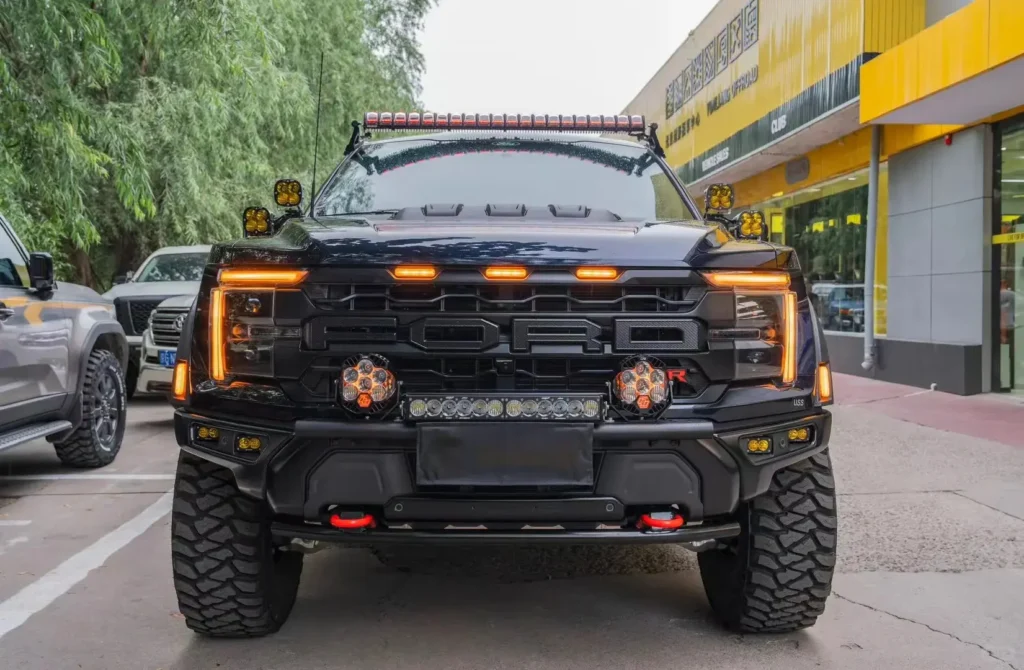
If you sell Auto-Grillleuchten, here’s a structure that tends to work well:
1) One-line positioning (what it is)
Example: “Add-on LED accents for the grille area to sharpen the vehicle’s front profile.”
2) Intended use (clear, early)
- “Designed for off-road/show/private property use where permitted.”
3) Modes and colors (list them plainly)
- “Lighting options include solid white, solid amber, plus flash/strobe settings (details below).”
Then add a short note:
- “Public-road requirements can vary, and certain colors or flash patterns may not be permitted in your area. Verify local laws before use.”
4) Fitment notes (to avoid returns)
- “Universal fitment—mounting location varies by vehicle.”
- “Not recommended for vehicles with active grille shutter interference.”
- “Avoid blocking front sensors (radar/cameras).”
5) What’s included / what’s not
Avoid vague language. Make it clear what the customer gets and what they’ll need.
6) Warranty language that doesn’t promise legality
Your warranty should cover product defects, not legal outcomes.
A “Modes” Warning That Customers Actually Read
Most customers don’t read long disclaimers. The key is putting the warning where their eyes already are: near the mode description.
Practical pattern:
- After listing flash/strobe patterns, add one short line:
- “Use flash/strobe functions only in off-road settings or on private land when allowed.”
This is simple, repeatable, and hard to misunderstand.
Customer Support Scripts (Copy-Paste Templates)
If you’re doing support, the goal is consistency. You want answers that are clear, not emotional, and not legally risky.
Script A: “Are these street legal?”
“What’s allowed depends on your jurisdiction and on the settings you run (color, steady vs. flash) as well as the use case and environment. Our grille lights are sold as auxiliary/accent lighting intended for off-road/show/private-property use where permitted. Please check your local regulations to confirm what’s allowed for on-road use in your area.”
Script B: “Is flashing allowed for on-road driving?”
“Many jurisdictions restrict flashing auxiliary lights on public roads. Flashing modes are intended for off-road/private property use where permitted. For on-road driving, we recommend steady modes only and verifying local regulations.”
Script C: “Is amber/white allowed?”
“Local rules depend not only on where you are, but also on configuration (brightness, placement, and whether the light is constant or flashing). In many areas, steady amber/white auxiliary lighting may be allowed, but we can’t confirm legality for every jurisdiction. Please verify your local regulations before on-road use.”
Script D: “I got pulled over—can I return them?”
“I’m sorry to hear that. Because on-road legality varies by location and usage, we recommend verifying local regulations before use. We can help with a return if the product is unused/within the return window (or troubleshoot if there’s a product issue). Tell us your order number and whether the lights were installed/used.”
(Adjust to your actual return policy, but keep the tone consistent.)
The Return Policy Trap: Don’t Let Compliance Become “Free Rentals”
Some businesses unintentionally create a loophole:
- customer installs lights
- uses them
- gets unwanted attention
- returns as “not legal”
To reduce abuse without sounding hostile:
- clearly state “returns must be in like-new condition”
- clarify whether installed products are returnable
- emphasize that legality depends on the user’s location and configuration
This isn’t about being strict. It’s about not taking on legal responsibility you can’t control.
Marketplace Listings (Amazon/eBay) and Short-Form Compliance Text
If you have limited space, here’s a minimal compliance block that still helps:
- “Grille-mounted auxiliary LED accents for off-road and exhibition use (where allowed).”
- “Flashing modes intended for off-road/private property use.”
- “Verify local regulations for on-road use (color/mode/placement).”
It’s not perfect, but it prevents the worst misunderstandings.
A Quick “Responsible Use” Section That Builds Brand Trust
Adding a short section titled “Responsible Use” can actually help conversions because it signals you’re not selling junk to reckless users.
Keep it short:
- Use steady modes in traffic
- Avoid glare; aim responsibly
- Respect local laws and restrictions
- Don’t interfere with sensors or airflow
It’s not preachy. It’s professional.
Closing: The Cleanest Compliance Strategy Is Honest, Specific Communication
If you want to sell led grill leuchten without constant disputes, the goal isn’t to argue about what’s legal where. The aim is to set expectations with messaging that is:
- accurate
- non-absolute
- easy to understand
- placed where customers will actually see it (modes, color options, intended use)
Do that, and you reduce returns, reduce angry emails, and protect the long-term reputation of your product and your brand—without killing the fun of a clean grille-light build.


 English
  Spanish
  Vietnamese
  Thai
Thai  Arabic
  Russian
  Malay
Malay  French
  German
  Hindi
Hindi