
Last year we had a buyer who did everything “right” in the usual way. Sample approved, beam looked clean, packaging was fine, price was stable. Then the first shipment landed, and the first problem was not fogging, not flicker, not tabs.
It was a message from their freight forwarder:
“Customs is asking why the product marking and the declared description don’t match.”
The goods didn’t disappear. Nobody accused anyone of fraud. But the container sat. Storage cost started. Their customer’s launch date slipped. And their sales team had to answer the worst kind of question: “So… is this legal?”
That’s why we’re writing this as a factory note for B2B Beschaffung teams. If you buy OEM-Projektorscheinwerfer for cross-border sales, the product has to work on the road—but it also has to survive paperwork, listing rules, and inspection habits in your target market.
This is the part most buyers only learn after a shipment gets stuck.
Where “OEM” gets you in trouble: it’s a sales word, not a compliance position
We understand why buyers use the word OEM. It’s short. It signals “factory-like.” It sells.
But when someone challenges your shipment (customs, platform policy, a big distributor account), they don’t evaluate “OEM feel.” They evaluate three boring things:
- What functions the lamp has (low/high/DRL/position/turn, etc.)
- What is marked on the product (lens/housing markings, left/right drive intent, identifiers)
- What documents you can provide for the exact SKU that shipped
If one of these doesn’t align, you don’t get a technical debate. You get delay, delisting, or rejection.
From our side, we can build to a defined target. What we can’t do is guess your market rules from a WhatsApp message that says “OEM quality, please.”
The marking trap: small engraving decisions create big commercial risk
Many disputes start with a buyer treating markings as “artwork.”
Markings are not artwork. Markings are how the market identifies what you sold.
Two common ways programs get messy:
1) “Same model name” but different markings across batches
This happens when buyers change markets (or channels) mid-program and ask for a quick marking change without separating SKUs.
Result in the real world:
- Warehouse mixes inventory.
- Resellers pull stock randomly.
- A customer receives a unit whose marking doesn’t match the listing claim.
- Now you have a compliance argument, not a quality issue.
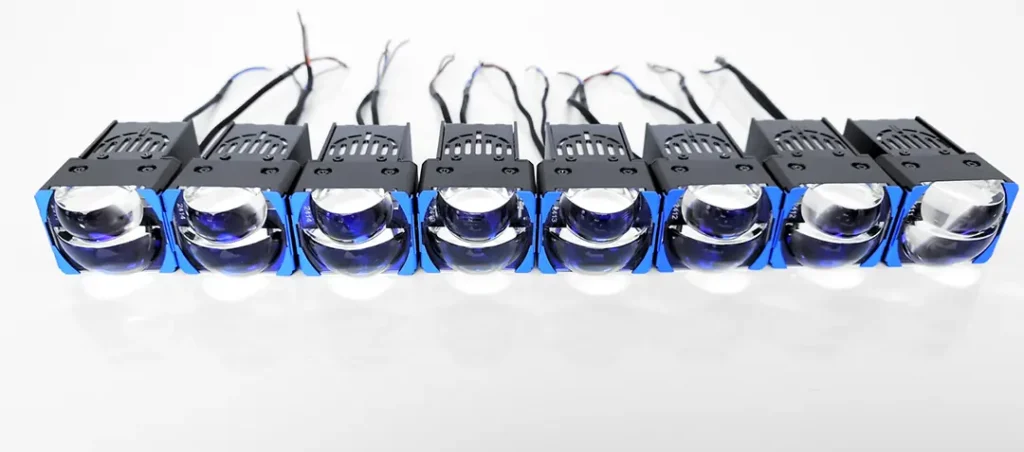
2) LHD/RHD confusion that turns into returns (or worse)
In projector optics, LHD vs RHD is not a preference. It’s fundamental behavior.
What we see in B2B chains:
- Buyer sells to two countries with different drive sides.
- Packaging gets split locally.
- Someone re-ships one unit without checking.
- The installer fits it, aims it, and the customer complains about glare or poor road illumination.
- Buyer blames factory; factory checks photos; the unit is correct—just for the wrong side.
If you sell OEM Projektorscheinwerfer into mixed markets, you must treat LHD/RHD separation like you treat currency. You don’t “mostly” separate it.
The document mistake: asking for “a certificate” instead of asking for “a match”
We often receive requests like:
- “Send certificate.”
- “Need approval paper for customs.”
- “Need something to show customers.”
If the document does not match the shipped configuration and the marked identity, it doesn’t protect you. It can make the situation worse, because it looks like you’re using generic paperwork.
A safer way to think about documents is:
You need documents that match the exact shipped SKU configuration and the exact product marking.
That means procurement has to be specific. For OEM projector headlights, “specific” usually includes:
- target market (first destination, and any planned re-export)
- drive side (LHD or RHD)
- function set (low/high/DRL/turn/position; what is included and what is not)
- model identifier you will use on cartons and listings
- marking plan (what is marked on lens/housing, and where)
If you can’t define those five items clearly, nobody can give you clean, defensible paperwork.
What we need from you before we quote “compliance-ready” OEM projector headlights
Here is the exact message format that makes projects smooth on our side. Buyers who send something like this usually get faster sampling and fewer surprises later.
RFQ input (copy/paste):
- Market(s): ______
- Sales channel: distributor / installer chain / marketplace / tender / other ______
- Drive side: LHD / RHD
- Functions needed: low / high / DRL / position / turn (select)
- Product naming rule (your SKU): ______
- Marking request: lens marking / housing marking / none / to be confirmed
- Outer carton label fields required: ______
- Listing claim limits (what you will say publicly): ______
- Any documents required by your customer/customs/platform: ______ (name the exact requirement if you know it)
Why we ask for “listing claim limits”: because many problems are caused by over-claims, not by the lamp itself. If your listing says something that your shipment can’t support, your program becomes a target.
What we can commit to as a factory—and what we will not “promise” for you
Let’s be direct, because this saves time.
What we can commit to
- Build the OEM projector headlights to the confirmed configuration.
- Keep the identity consistent across production (marking plan + labeling plan + configuration definition).
- Provide shipment-linked production and inspection records for the units we ship (within the scope agreed).
What we will not promise without validation
- “Legal in all countries.”
- “Approved everywhere.”
- “Platform will never delist.”
- “Pass any inspection just because the beam looks good.”
Compliance is not one global switch. It’s market-by-market, and sometimes platform-by-platform.
If your market requires a specific approval path, we can discuss it—but the conversation must be tied to a specific SKU and a specific target standard, not the word “OEM.”
A simple way to avoid mixed inventory and mixed claims: separate SKUs by identity, not just by price
Here is a pattern that works in real distribution:
- If the marking plan differs → separate SKU
- If LHD vs RHD differs → separate SKU
- If the function set differs → separate SKU
- If the listed compliance claim differs → separate SKU
Buyers resist this at first because they want fewer SKUs. But fewer SKUs only helps if your downstream chain behaves perfectly. Most chains don’t.
One extra SKU is cheaper than:
- one stopped shipment,
- one marketplace takedown,
- or one distributor account saying “don’t ship this again.”
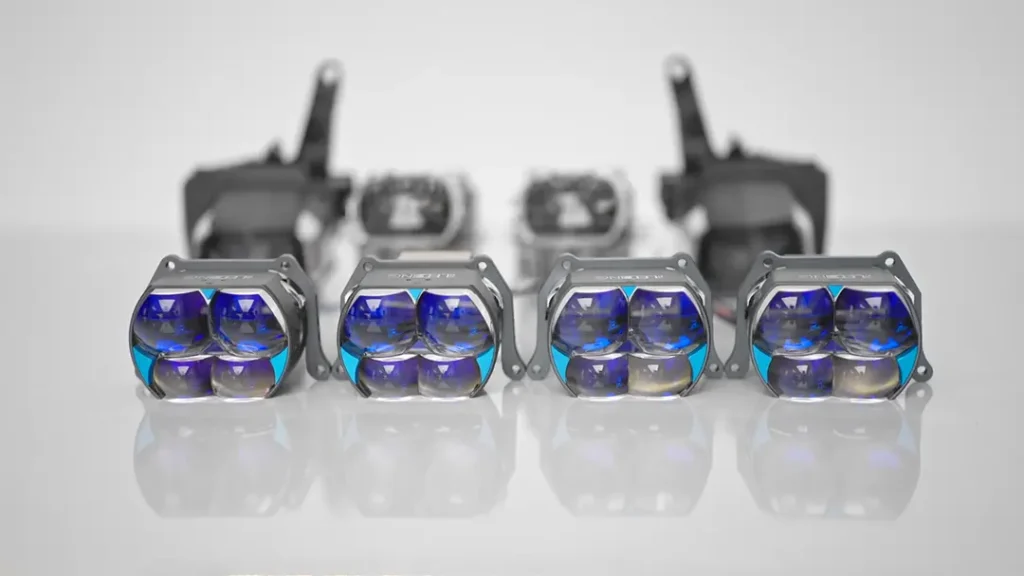
The “don’t make us guess” checklist for your first PO
If you want your first OEM projector headlights order to ship cleanly and remain reorderable, put these on the PO/PI level (not only in chat):
- Drive side: LHD or RHD (written clearly)
- Function set (written clearly)
- Product ID on carton label (exact text)
- Marking plan reference (even a simple photo of the approved marking location is enough)
- Listing claim limits (one sentence is fine: “No claim of ___ in public listings.”)
This doesn’t make the order complicated. It makes it defendable.
Why we’re strict about this: “good product, bad identity” still kills programs
Factories hate rework. Buyers hate delays. Platforms hate ambiguity. Customs hates inconsistency.
When identity is stable:
- your warehouse can pick correctly,
- your reseller can list correctly,
- your support team can answer questions quickly,
- and reorders feel the same as the first PO.
When identity drifts:
- everything becomes “maybe,”
- and “maybe” is expensive in B2B.
OEM projector headlights are not only optics + sealing + electronics. For cross-border B2B, they’re also: identity, marking, and documentation that match.
That’s not marketing. That’s how you keep product moving.


 English
  Spanish
  Vietnamese
  Thai
Thai  Arabic
  Russian
  Malay
Malay  French
  German
  Hindi
Hindi