
Car lighting is one of those topics people only notice when something goes wrong—or when they drive a road that makes them wish they’d upgraded sooner. Maybe you’ve seen a vehicle with a pair of round auxiliary lamps on the bumper, or a bright light bar mounted up front, and wondered what’s actually useful versus what’s just bright for the sake of it.
This guide clears up the basics: what the lights on a car are called, what spotlights are and what they’re for, whether a light bar is better than spotlights, and the big question that always comes up during upgrades: is it legal to put LED lights in your car?
What are the lights called on a car?
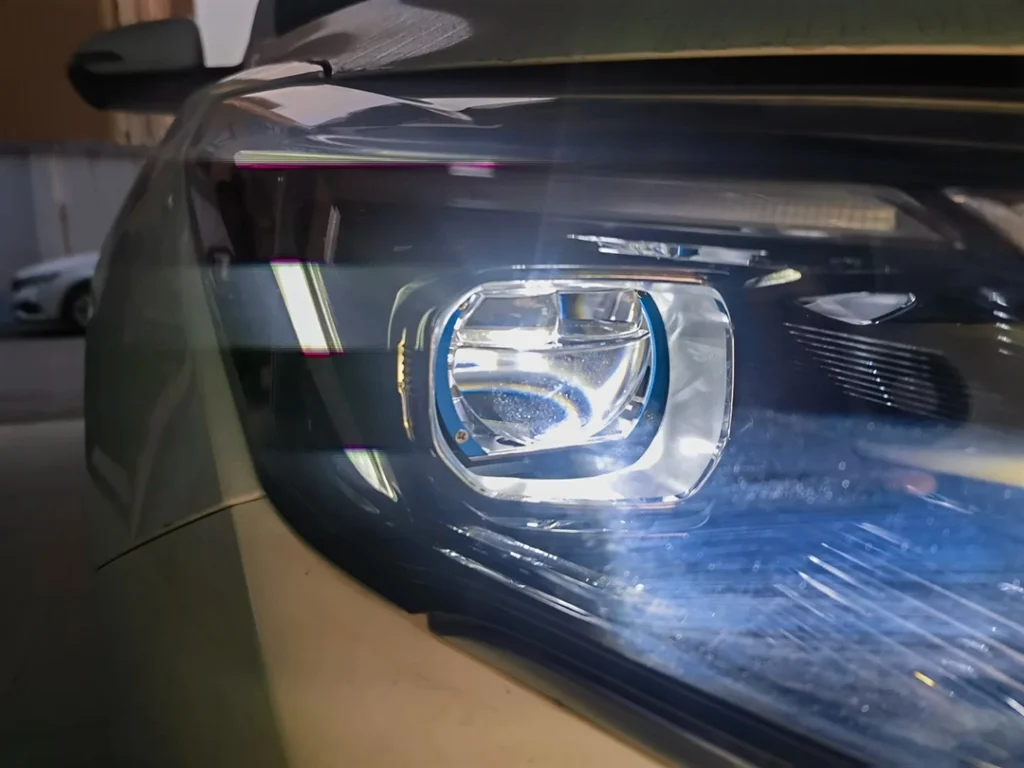
Before you decide what to add, it helps to know what you already have. Most cars share the same core light types, even if the shape and styling are different.
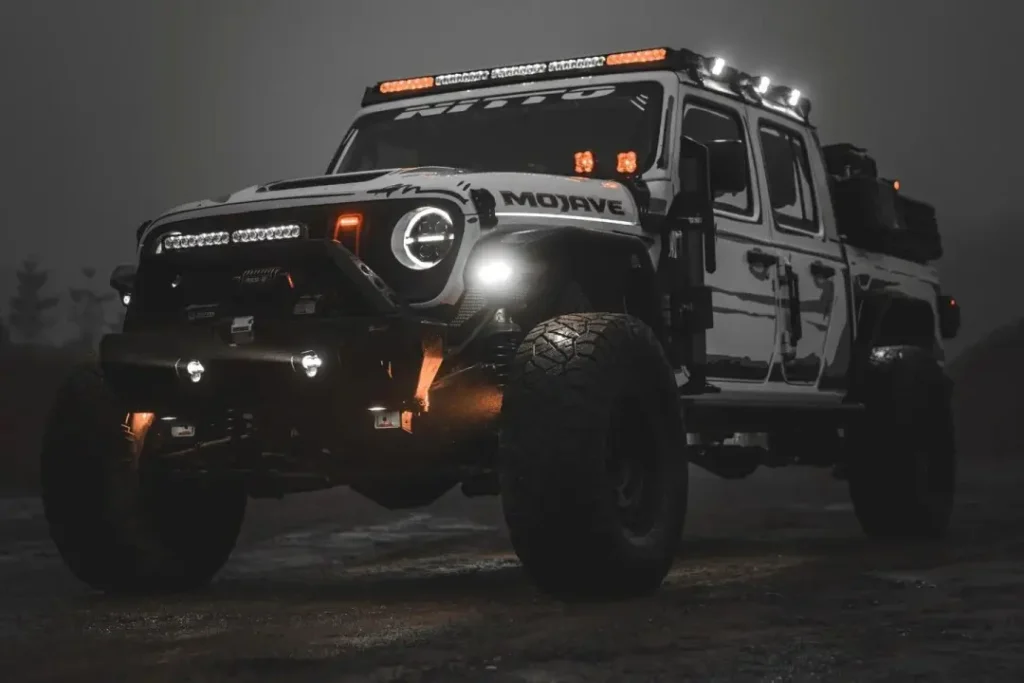
The everyday exterior lights (quick glossary)
- Headlights (low beam / dipped beam): Your main night-driving light. Designed to light the road without blinding oncoming traffic.
- High beam (main beam): Long-range light for dark roads with little or no oncoming traffic. Powerful, but easy to misuse.
- Daytime Running Lights (DRLs): Visibility lights meant to help others see you in daylight. DRLs aren’t a substitute for headlights at night.
- Faros antiniebla (front): Low-mounted lights designed to reduce glare in fog/rain by aiming low and wide.
- Tail lights: Rear running lights that are on when your headlights are on.
- Brake lights: Bright red lights that intensify when you brake.
- Turn signals / indicators: Amber lights that signal lane changes and turns.
- Reverse lights: White lights that come on when you shift into reverse.
- Rear fog light (where fitted): A bright red rear light used in heavy fog to make you visible from behind.
The “extra” lights people add
- Auxiliary driving lights: Extra forward lighting to supplement high beams.
- Focos (spot beams): A type of auxiliary light with a tight, long-distance beam.
- Flood lights (wide beams): A broader beam for close-to-mid range.
- Light bars: A row of LEDs that can be configured as spot, flood, or combo patterns.
Knowing these terms matters because laws and safe-use guidelines often treat factory headlights differently from auxiliary/off-road lighting.
What is the purpose of spotlights?
If you strip away the marketing language, the purpose of spotlights is simple:
Spotlights are designed to throw light far down the road.
They’re most helpful when:
- you drive on unlit highways and need more reach than your standard high beams provide,
- you’re in rural areas with animals or pedestrians near the edge of the road,
- you do long-distance night driving and want earlier detection time.
Spot beam vs “brighter headlights”
A common misconception is that upgrading your headlight bulbs alone will automatically improve long-distance visibility. Sometimes it does—but often the limiting factor is optics and beam pattern, not raw brightness.
Spotlights help because they:
- concentrate light into a narrow hotspot,
- reduce wasted light in areas you don’t need (like tree tops and signboards),
- extend usable visibility at speed.
Where spotlights can be a bad idea
Spotlights are not magical. They can create problems when:
- used in traffic (glare to others),
- aimed too high,
- paired with poor wiring that causes flicker or voltage drop,
- installed without considering heat, water sealing, and vibration.
In practice, a well-aimed, road-legal headlight setup beats a sloppy “sun on the bumper” install every time.
What are spotlights on a car?
On a car, spotlights are usually auxiliary forward-facing lights mounted on the bumper, grille, or a bracket near the front. They’re commonly round or square, and they’re meant to be used like (or with) luces altas, not as everyday low beams.
How to recognize spotlights
You’ll typically notice:
- a compact lamp body,
- a focused lente or reflector designed for distance,
- mounting hardware that looks aftermarket (brackets, clamps, custom mounts).
Some vehicles—especially older models, rally-inspired builds, and utility vehicles—may have factory-fitted auxiliary lamps, but most spotlights you see are aftermarket.
The right way to use spotlights (from a safety standpoint)
Think of spotlights as a tool for empty, dark roads. Good etiquette (and good survival instincts) looks like this:
- Use them only when there’s no oncoming traffic and you’re not following closely behind another vehicle.
- Wire them so they only activate with high beam (common best practice).
- Aim them carefully so the hotspot sits en la carretera, not in people’s mirrors.
Is a light bar better than spotlights?
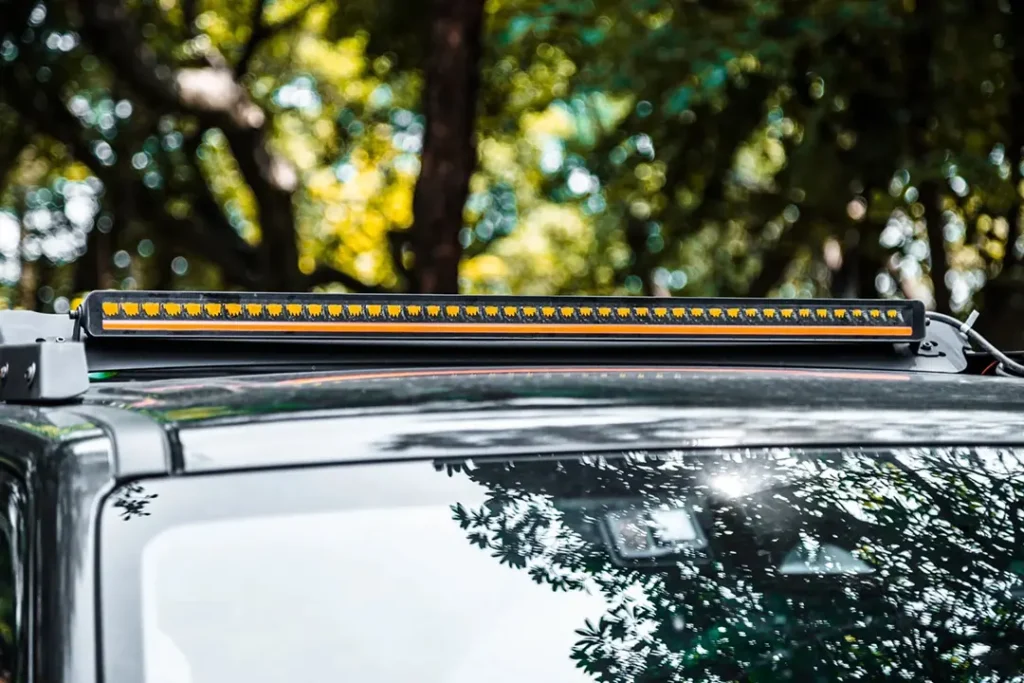
It depends on what you want your car to do at night. “Better” here is really about forma del haz y use case.
The simple comparison
- Spotlights: narrow beam, long reach, best for higher-speed driving on dark roads.
- Light bars: can be spot, flood, or combo; often provide more total light and wider coverage, especially close to mid-range.
When a light bar makes more sense
A light bar is often the better tool if you need:
- wide peripheral visibility (shoulders, ditches, trails),
- slower-speed driving (off-road, worksites, rural property),
- an even “wall of light” for close and mid distances.
That’s why you see light bars on off-road vehicles, pickups, and utility rigs.
When spotlights win
Spotlights tend to be better if you care about:
- distance vision at highway speeds,
- a controlled, focused beam,
- less wasted light spilling everywhere.
The “combo” trap
Many light bars are sold as “combo beams” (spot + flood). That can be useful—if it’s a quality unit with decent optics. Cheap bars often create lots of scatter: it looks bright, but your distance vision may not improve much, and glare can be brutal.
If you want one practical rule: For road use, beam control matters more than maximum brightness.
Is it legal to put LED lights in your car?
Legality depends on your country/state, but the pattern is surprisingly consistent across many regions:
- Factory-fitted LEDs (OEM) are generally legal because they’re certified as a system.
- Aftermarket LED bulbs in halogen housings are often a legal grey area or outright illegal, because the headlamp was not approved for that light source.
- Auxiliary LEDs (spotlights/light bars) may be legal to install but illegal to use on public roads, or they may require covers, specific mounting positions, or independent switches and indicator lights.
Why laws care (it’s not just bureaucracy)
Headlights are regulated because uncontrolled light causes:
- glare that reduces oncoming drivers’ ability to see,
- unsafe beam patterns (too much foreground, not enough distance),
- misleading brightness that feels “better” to the driver but worsens overall road safety.
So when people ask, “Is it legal to put LED lights in your car?” the real legal question is usually: Will your lights meet road standards for beam pattern, intensity, aim, and glare control?
The safest “legal-friendly” upgrade path
If your goal is LED performance without drama:
- Choose headlamps designed for LED (OEM LED units or certified assemblies).
- If upgrading bulbs, confirm your housing type and pick solutions that preserve a correct cutoff and beam pattern.
- For spotlights/light bars, treat them as high-beam/off-road tools and wire/aim them accordingly.
A note on inspections and insurance
Even if enforcement is inconsistent, inspections and post-accident checks can be less forgiving. If your setup is clearly dazzling or non-compliant, it can create avoidable trouble when you least need it.
(Real talk: the road doesn’t care that the product listing said “CANBUS OK SUPER BRIGHT.”)
Choosing the right setup: a quick decision framework
Most people don’t need more lights—they need better light in the right place.
Ask yourself these questions
- Do you mostly drive in the city with street lighting?
- Do you do highway night driving at speed?
- Is your problem distance reach, side visibility, o rain/fog performance?
- Are you upgrading for style, or for fatigue reduction and safety?
Practical recommendations
- City-focused driving: prioritize well-aimed low beams, clear headlamp lenses, and reliable bulbs. Extra auxiliary lights often add glare more than benefit.
- Dark highways: consider controlled long-range lighting (spot-style auxiliary lights) used responsibly with high beam.
- Off-road/work use: a quality light bar can be excellent for wide coverage—just keep road legality and switching etiquette in mind.
Key takeaways (the stuff you’ll actually remember later)
- What are the lights called on a car? Headlights, high beams, fog lights, DRLs, tail/brake lights, indicators, reverse lights—plus optional auxiliary lights.
- What are spotlights on a car? Auxiliary forward lights with a tight beam, built for distance and typically used with high beam.
- What is the purpose of spotlights? To extend how far you can see on dark roads—useful at speed, useless (and rude) in traffic.
- Is a light bar better than spotlights? Light bars usually win on width and close/mid coverage; spotlights often win on long-distance reach.
- Is it legal to put LED lights in your car? Sometimes yes, sometimes no—legality usually depends on whether the whole lighting system meets beam and glare standards, not just whether the bulb “fits.”
 English
  Español
  Tiếng Việt
  ไทย
ไทย  العربية
  Русский
  Bahasa Melayu
  Français
  Deutsch
  हिन्दी