
La plupart des phare projecteur Les problèmes d'approvisionnement ne commencent pas par un “mauvais produit”. Ils commencent par un mauvaise définition.
Une annonce indique “phares projecteurs d'usine”, un fournisseur indique “phares projecteurs OEM” et votre client dit “je veux des phares projecteurs personnalisés”. Tout le monde acquiesce et, trois mois plus tard, vous vous retrouvez avec le presse-papier le plus cher du monde : les retours de garantie, condensation des plaintes, des modèles de faisceau incohérents, ou un lot qui semble correct le premier jour et qui se transforme en générateur de tickets d'assistance le trentième jour.
Ce guide s'adresse aux les distributeurs, les ateliers de rénovation et les équipes chargées de l'approvisionnement en produits de marque acheter en Asie du Sud-Est, au Moyen-Orient, en Afrique, en Amérique du Sud et en Russie. Il ne s'agit pas d'un tutoriel d'installation. Il s'agit d'un manuel de sourcing : comment traduire les mots marketing en mots d'affaires. exigences vérifiables, Comment qualifier un partenaire industriel et comment protéger les marges grâce à des conditions commerciales et de contrôle de qualité pratiques.
1) Les quatre mots-clés qui déterminent votre résultat (et votre taux de garantie)
Avant de comparer les devis, vous devez aligner ce que ces catégories signifient réellement en termes de marchés publics.
Un tableau de définition pratique (à utiliser dans votre appel d'offres)
Voici la manière la plus simple de transformer les quatre mots-clés en logique d'achat :
| Catégorie | Ce que cela signifie généralement | Meilleur pour | Priorité à la passation de marchés | Risque commun |
|---|---|---|---|---|
| Projecteurs de rechange | Produits prêts à l'emploi pour les marchés de remplacement et de mise à niveau | Distributeurs, revendeurs multi-pays, magasins ayant besoin d'un chiffre d'affaires rapide | Cohérence des lots, taux de DOA, vitesse de RMA, contrôle des dommages causés par l'emballage | “Les photos sont bonnes, mais les lots ne sont pas homogènes. |
| Projecteurs personnalisés | Personnalisation ODM : spécifications + image de marque + parfois modification de la structure/optique | Les marques se différencient | Contrôle des modifications (ECN), gel de la conception, outillage/IP, plan de validation | Révisions incessantes, dérapage des coûts, retards de lancement |
| Projecteurs OEM | Soit une véritable chaîne d'approvisionnement OEM, soit une revendication de “qualité OEM”. | Les acheteurs qui ont besoin de stabilité et de documentation | Preuves : traçabilité, dossiers d'essai, nomenclature stable, contrôle des processus. | “OEM” utilisé comme label sans preuve |
| Projecteurs d'usine | Directement du fabricant (ce n'est pas toujours le cas) | Les acheteurs tentent de réduire le nombre de couches et de prendre le contrôle | Auditabilité, capacité de production, contrôles de qualité, planification des capacités | Société commerciale se faisant passer pour une usine |
Principaux enseignements : Il ne s'agit pas seulement de types de produits. Ils sont profils de risque. Votre tâche consiste à choisir le profil de risque que vous pouvez gérer de manière rentable.
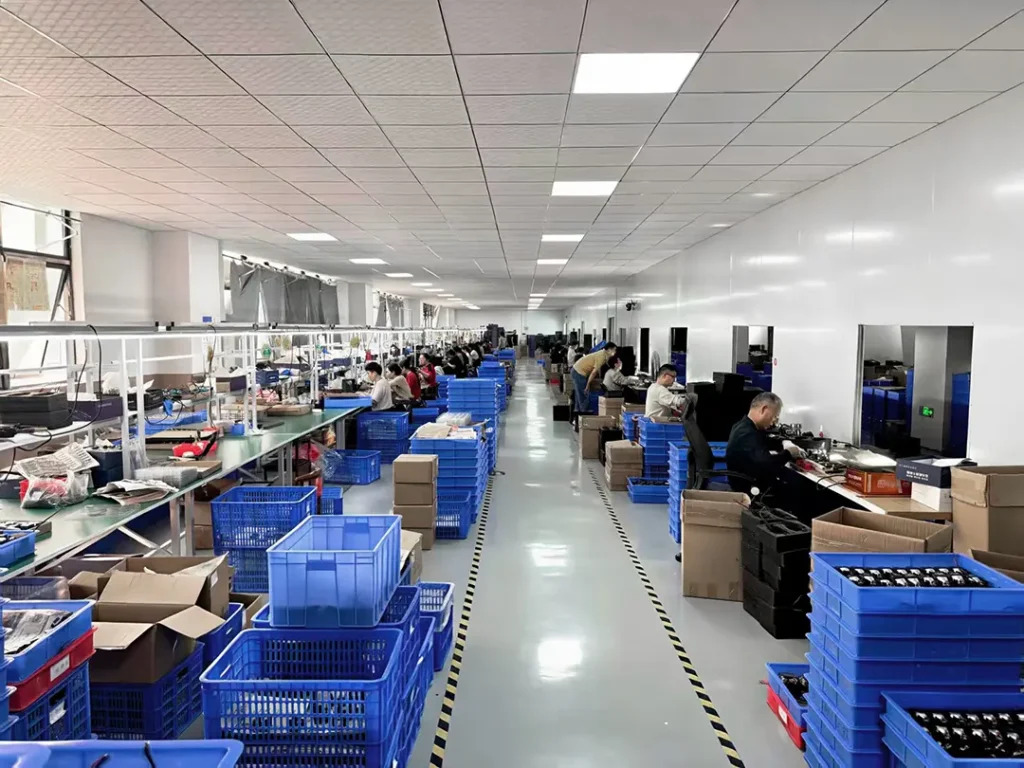
2) “Projecteurs d'usine”n'est pas une promesse - vérifiez-le
Sur de nombreux marchés d'exportation, le terme “usine” peut désigner aussi bien un fabricant à part entière qu'une petite chaîne de montage louant un espace derrière un entrepôt. Il n'est pas nécessaire d'être méfiant, il faut être systématique.
Ce qu'un véritable partenaire d'usine devrait pouvoir montrer (rapidement)
Demandez-les avant même de demander le prix final :
- Clarté du champ de production
- Quelles sont les étapes internes ou externalisées (assemblage, essais, emballage au minimum).
- Traçabilité
- Numéros de série ou codes de lot qui renvoient à la date de production et aux registres d'inspection.
- CQ en cours de fabrication
- Contrôle à l'entrée (IQC), contrôles en cours de fabrication (IPQC), contrôle à la sortie (OQC).
- Capacité de vieillissement / déverminage
- Même une station de vieillissement de base est préférable à la formule “nous testons une seule pièce”.”
- Normes d'emballage
- Approche Drop-test ou au moins fiches techniques de l'emballage et photos de l'emballage à l'exportation.
Un test brutal mais utile
Demander un Exemple de rapport récent de l'OQC (en supprimant les informations sensibles). Les vrais fabricants ont généralement des modèles, des tolérances et des règles de réussite ou d'échec. La formule “Nous vérifierons avant l'expédition” n'est pas un système, c'est une prière.
3) Projecteurs de seconde monte : gérer le coût total et non le prix unitaire
Pour les distributeurs et les magasins, le coût réel n'est pas le prix du carton, c'est le prix de l'emballage. charge de soutien:
- Temps de travail consacré au diagnostic “le client dit qu'il y a de la buée”.”
- Frais d'expédition pour les remplacements
- Atteinte à la réputation (en particulier sur les marchés régis par WhatsApp où les mauvaises nouvelles circulent à la vitesse de la fibre)
Ce que vous devez spécifier dans votre PO (clauses simples et puissantes)
- Définition et fenêtre DOA : par exemple, DOA dans les 7 jours suivant la réception, avec preuve photo/vidéo.
- Fenêtre d'échec précoce : par exemple, les échecs dans les 30 à 90 jours sont traités comme des crédits de remplacement.
- Attentes en matière de cohérence des lots : le fournisseur confirme la stabilité de la nomenclature pour la commande, sans substitutions non approuvées.
- Responsabilité des dommages causés par l'emballage : définir ce qui est considéré comme une avarie de transport et comment les réclamations sont traitées.
Des points de contrôle du contrôle qualité qui réduisent considérablement les retours
Vous n'avez pas besoin d'un laboratoire. Vous avez besoin de portes reproductibles :
- Aspect et forme : languettes de montage, clarté de la lentille, déformation du boîtier
- Test fonctionnel : commutation feux de croisement/feux de route, clignotant/DRL le cas échéant
- Stabilité électrique : pas de scintillement à tension stable ; connecteurs en place ; comportement de charge de base
- Examen du risque d'humidité : inspection visuelle du joint rapide ; confirmation de la présence de l'évent et du joint
- Documentation : code de lot enregistré par carton (les réclamations futures deviennent solvables)
Si vous ne faites qu'une seule chose : enregistrer les codes de lot et les relier aux expéditions des clients. Sans traçabilité, chaque problème devient “tous les lots sont mauvais”, même si un seul l'est.
4) Projecteurs personnalisés : rendre l'ODM prévisible (et rentable)
Les marques gagnent à personnaliser le programme lorsqu'il est géré comme un projet, et non comme une discussion de groupe.
Le cadre ODM que les acheteurs devraient exiger
Pour éviter que les phares projecteurs personnalisés ne deviennent une boucle de révision sans fin, adoptez une approche progressive :
- Verrouillage du concept (confirmation des spécifications)
- Intention du faisceau, marchés cibles, emballage, image de marque, accessoires nécessaires
- EVT (Validation de l'ingénierie)
- Peut-il être construit ? Est-il adapté à la plate-forme ? Les composants de base sont-ils stables ?
- DVT (Validation de la conception)
- Les objectifs de performance et de fiabilité sont-ils atteints ? La conception résiste-t-elle à des contraintes réalistes ?
- PVT (Validation de la production)
- La production de masse permet-elle d'obtenir un rendement constant avec des taux de défaut acceptables ?
Deux clauses qui sauvent votre calendrier
- Date de gel de la conception : Ensuite, les modifications nécessitent un ECN et peut avoir une incidence sur le prix et le délai de livraison.
- Processus ECN : chaque changement doit inclure :
- numéro de version
- raison du changement
- l'évaluation de l'impact (coût, délai, compatibilité)
- dossier d'approbation
Outillage et propriété intellectuelle (ne pas sauter cette étape, même si tout le monde est amical)
Si vous construisez une marque :
- Définir propriété de l'outillage (vous, fournisseur, ou partagé)
- Définir exclusivité (par pays ou par canal)
- Définir que se passe-t-il si le partenariat prend fin ? (moules, dessins, éléments de marque)
La personnalisation peut être un fossé ou un piège. Ce qui fait la différence, c'est la paperasserie et la discipline, pas la chance.
5) Phares projecteurs OEM : remplacer le mot “OEM” par des preuves
“L'expression ”phares projecteurs OEM" est la plus mal comprise de cette catégorie. Le véritable statut de la chaîne d'approvisionnement OEM est difficile à revendiquer et à conserver. Pour les acheteurs, la solution la plus pratique consiste à demander Preuve de type OEM, et non une formulation de type OEM.
Le “dossier de preuves” que vous pouvez demander sans être ingénieur
- Confirmation stable de la nomenclature
- Composants clés verrouillés pour votre commande (lentille, driver/ballast, câblage, joints, matériau du boîtier)
- Dossiers d'essais (même internes)
- Résultats du vieillissement et du rodage, exposition à la température, dépistage des vibrations, contrôles de l'infiltration d'eau
- Preuve de contrôle de processus
- Fiche de contrôle du premier article, fiche de contrôle en cours de fabrication, rapport d'inspection sortant
- Traçabilité
- Codage de série/de lot lié aux enregistrements de production et de contrôle de qualité
- Politique de garantie liée aux données
- Comment les demandes sont-elles classées, quelles sont les preuves requises, quels sont les délais de remplacement/crédit ?
Si un fournisseur vous dit qu'il est “de qualité OEM”, votre réponse doit être la suivante : “Très bien - montrez-moi votre plan de contrôle et la manière dont vous empêchez les substitutions de composants non approuvées”. Les meilleurs partenaires ne seront pas offensés. Ils seront soulagés de voir que vous êtes sérieux.
6) Réalités régionales : SEA, MENA, Afrique, LATAM, Russie (les spécifications devraient suivre le climat)
Une erreur fréquente en matière d'approvisionnement consiste à acheter une spécification et à l'appliquer à cinq environnements opérationnels très différents. Vos spécifications d'achat doivent refléter l'endroit où le produit vivra.
Asie du Sud-Est (SEA)humidité et averses
- Fixer des priorités résistance à la condensation et une étanchéité constante
- Exiger des orientations claires sur les évents/joints et la protection des emballages contre l'humidité
Moyen-Orient (MENA)la chaleur et la poussière
- Fixer des priorités stabilité thermique et résistance à la pénétration de la poussière
- Confirmer les attentes en matière de placement du conducteur et de traitement des défaillances dues à la chaleur dans le cadre de la garantie
AfriqueLes routes rugueuses et les infrastructures de service inégales
- Fixer des priorités tolérance aux vibrations et un service après-vente facile
- Faire de la disponibilité des pièces détachées un élément du contrat (conducteurs, harnais, capuchons)
Amérique du Sud (LATAM) : longues chaînes logistiques + conditions routières variables
- Fixer des priorités résistance de l'emballage à l'exportation et la traçabilité au niveau du carton
- Rendre les conditions RMA réalistes pour des temps de transit plus longs
Russiecycles de froid et exposition à des hivers rigoureux
- Fixer des priorités stabilité en cycle froid et le comportement de l'étanchéité en cas de variations de température
- Veiller à ce que les matériaux et les joints ne se fragilisent pas à basse température
Traduction : votre “UGS la plus vendue” pourrait avoir besoin de des emballages, des fenêtres de garantie et des seuils de contrôle de la qualité spécifiques à chaque région-même si le produit est techniquement le même.

7) Liste de contrôle de la coopération du distributeur (copier-coller dans l'intégration du fournisseur)
Voici une liste de contrôle pour l'approvisionnement qui fonctionne pour les programmes de marché secondaire, les programmes personnalisés, les programmes de type OEM et les programmes directs d'usine :
Commercial
- Période de validité des prix + règle de fluctuation des matières premières
- Définition du délai d'exécution (échantillon ou production de masse)
- MOQ + allocation mixte par conteneur
- Clarté des Incoterms + fenêtre de réclamation après l'arrivée
Qualité et traçabilité
- Codage de lot/série requis sur le produit et le carton
- Rapport OQC joint par envoi
- NQA ou méthode d'échantillonnage approuvée (même simple)
- Pas de substitutions de nomenclatures non approuvées (écrites)
Après-vente
- Politique d'annulation et d'échec précoce (fenêtres temporelles + type de preuve)
- Méthode de remplacement (note de crédit ou réexpédition) et calendrier
- Disponibilité et prix des pièces de rechange
- Voie d'escalade : qui est responsable de l'analyse des causes profondes et des mesures correctives ?
Protection de la marque et des canaux de distribution (en particulier pour les produits sur mesure)
- Contrôle des marques et des emballages
- Conditions d'exclusivité par région/canal (le cas échéant)
- Propriété de l'outillage et gestion de fin de contrat
Si un fournisseur ne peut s'engager à respecter cette structure, vous n'achetez pas des phares, vous achetez de l'incertitude.
Clôture : le processus n'est pas réservé à l'atelier - il commence dès l'approvisionnement
Dans le monde de la rénovation, on dit que “le processus est plus important que les pièces”. Il en va de même pour les marchés publics : Le processus dépasse les promesses.
Que vous recherchiez des projecteurs de rechange pour une distribution rapide, que vous construisiez des projecteurs sur mesure pour le lancement d'une marque, que vous demandiez des projecteurs OEM (ou des preuves de qualité OEM), ou que vous choisissiez un partenaire de projecteurs d'usine pour un approvisionnement direct, la stratégie gagnante est la même :
- Définir la catégorie en termes de marchés publics
- Exigez des preuves, pas des adjectifs
- Intégrer le contrôle qualité et la traçabilité dans chaque envoi
- Aligner les spécifications sur les réalités régionales
- Mettre par écrit la garantie et le contrôle des changements
C'est ainsi que vous protégez vos marges, réduisez vos retours et vous développez vos activités en Asie du Sud-Est, dans la région MENA, en Afrique, dans la région LATAM et en Russie, sans être submergé par les tickets d'assistance.
 English
  Español
  Tiếng Việt
  ไทย
ไทย  العربية
  Русский
  Bahasa Melayu
  Français
  Deutsch
  हिन्दी
  Bahasa Indonesia