
En aftermarket projector headlights, “quality issues” often start before the customer ever turns the lights on.
A carton gets dropped at a hub. A pallet sits in humidity for two weeks. A forwarder stacks heavy freight on top “just for one night.” The product may still power on, but tabs are stressed, adjusters are knocked off center, lenses are scuffed, or a seam gets micro-cracked. Then the argument begins: factory vs shipper vs warehouse vs installer.
This export packaging standard is written in buyer language. It’s what we recommend for B2B programs that care about repeat orders, clean claims handling, and fewer “arrived damaged” tickets—without turning every shipment into overbuilt, overpriced armor.
1) What export packaging must prevent (define the failure modes first)
Before you choose foam or thicker cartons, be clear about what you’re trying to protect. For aftermarket projector headlights, the recurring damage modes we see in real export channels are:
- Impact / drops
- Broken mounting tabs, cracked housings, knocked adjusters, chipped lens edges.
- Vibration / abrasion
- Lens scuffs, bezel wear, rubbing marks on painted surfaces, harness chafing.
- Compression / stacking
- Deformed cartons leading to corner lens pressure, bracket bending, tab fatigue.
- Moisture / humidity
- Water marks on lens, corrosion on terminals, moldy cartons, softened inner paper.
- Mixing errors
- LHD/RHD mix, Rev mix, wrong SKU shipped—often caused by weak outer labeling.
A packaging standard isn’t “more material.” It’s targeted protection + clear identification.
2) Packaging architecture (the safest structure that still ships efficiently)
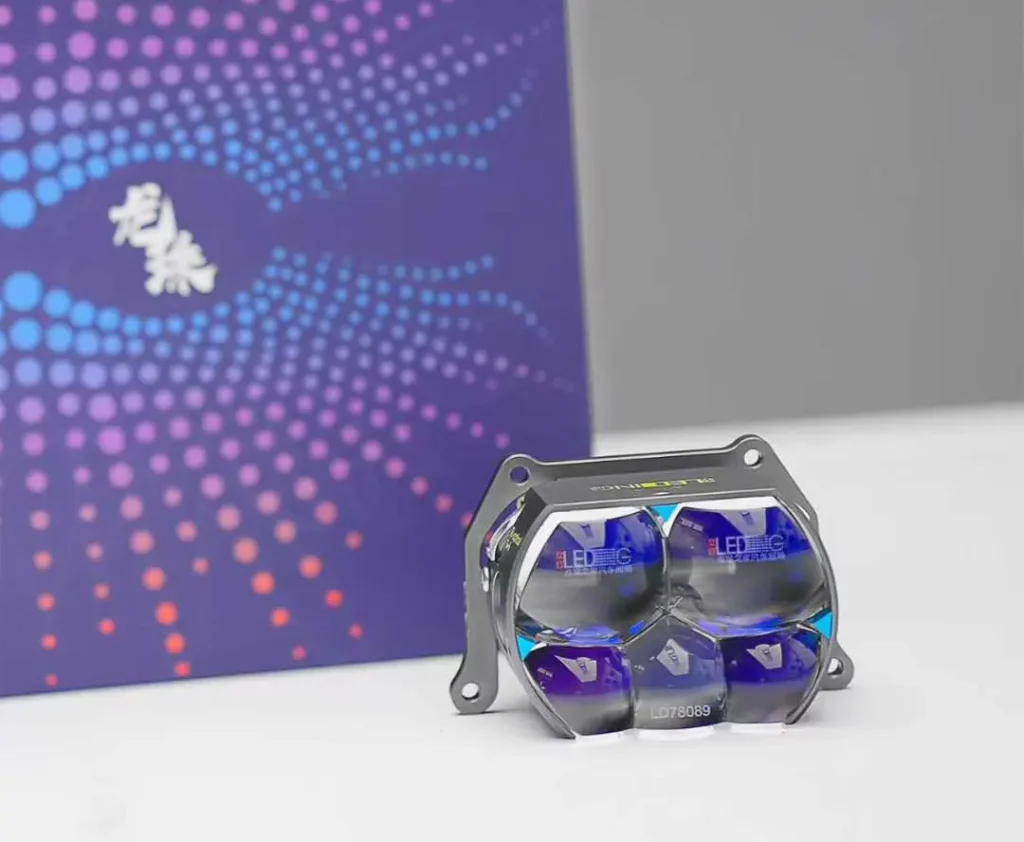
A reliable export pack for aftermarket headlights is typically a three-layer system:
- Primary protection (product-level)
- Dust bag / protective film on lens
- Terminal caps (or sealed bag for connectors)
- Cushioning & immobilization (inner pack)
- EPE/EPP/PU supports that hold the headlamp by strong areas, not by tabs
- Anti-rub spacers to keep lens from touching anything hard
- Transport protection (outer pack)
- Strong corrugated carton with corner protection and correct orientation markings
The single most important principle
Never let the headlamp “float.”
If the product can move inside the carton, it will eventually punch its own tabs and edges to death.
3) Protect the real weak points (what most packaging gets wrong)
3.1 Mounting tabs are not load-bearing
Tabs fail because packaging often “locks” the unit by the tabs (easy to design, disastrous in transit). Your inner supports should contact:
- main housing ribs
- reinforced bracket bases
- non-cosmetic structural surfaces
Rule: No foam block should press directly on a thin tab, even if it “fits.”
3.2 Lens protection is about abrasion, not only impact
Most lens complaints are not cracks—they’re scuffs. Recommended:
- removable protective film on the lens surface (clean-peel, residue-controlled)
- a soft dust bag or non-woven wrap to prevent rub marks
- a “no-contact zone” so the lens never touches hard foam edges
3.3 Adjusters and aiming mechanisms need immobilization
An adjuster might survive one drop but shift slightly. Then installers report “aim won’t hold” or “beam looks off,” and it becomes a technical debate.
Packaging should prevent:
- rotational shock transfer into adjuster assemblies
- sustained compression on adjuster knobs
4) Inner cushioning materials (what to choose and why)
There’s no single perfect material. Choose based on your channel risk and your cost tolerance. Here’s a practical comparison buyers can use when confirming packaging.
| Material | Meilleur pour | Pour | Vigilance |
|---|---|---|---|
| EPE foam | Standard export | Low cost, easy shaping | Can compress over time; needs correct density |
| EPP foam | High-risk routes, better repeatability | Elastic recovery, strong shock performance | Higher cost; tooling matters |
| PU foam | Complex shapes | Good fit, soft contact | Can absorb moisture; aging varies |
| Molded pulp | Eco programs | Good structure, recyclable | Moisture sensitivity; edge abrasion risk |
Buyer-facing standard: whatever material you use, the pack must pass your channel reality—not a calm sample shipment.
5) Carton spec (what “strong enough” means in practice)
For export cartons, focus on three things: board strength, structure, and sealing.
5.1 Corrugated board grade
- Use a grade appropriate for stacking and long transit (your supplier can propose by kg load).
- Prioritize edge crush strength (stacking survival) and consistent glue quality.
5.2 Carton structure
- Prefer designs with strong corner support (corner posts or reinforced corners for heavy units).
- Avoid oversize cartons “for convenience.” Oversize creates movement and crush zones.
5.3 Tape / sealing
- Use consistent tape width and pattern.
- If humidity is common, consider moisture-resistant tape and carton coating options.
Simple field check: cartons that arrive “soft” or “oil-canned” are telling you the board grade is too light or the storage condition is hostile.
6) Moisture control (cheap insurance that prevents expensive arguments)
Humidity damage is sneaky: the product may be fine, but cartons get ugly, labels peel, and customers assume the product is compromised.
Recommended export moisture controls:
- Desiccant quantity matched to carton volume and transit duration
- Sealed poly bag around the unit for high-humidity routes (SEA is the classic case)
- Moisture indicator card for higher-value programs (helps settle disputes fast)
This is not about “making it waterproof.” It’s about controlling perception and preventing corrosion risk.
7) Drop & handling logic (make the pack survive how logistics really behaves)
Even if you don’t run a full lab test, you can define a buyer-acceptable “channel test” standard:
Recommended minimum handling simulation
- multi-orientation drop logic (corners/edges/faces) at a height that matches warehouse handling
- vibration exposure logic (or at least a “shake test” with a clear pass/fail)
- compression logic (stacking load equivalent)
Pass criteria should be visual and functional, not only “it turns on.” For aftermarket projector headlights, pass means:
- no broken tabs
- lens surface clean (no scuffs from packaging)
- no loose internal parts noise
- no connector damage
- carton integrity acceptable for resale (if your channel requires it)
8) Labeling standard (packaging is also an anti-mixing system)
A surprising number of claims are not “defects.” They’re wrong-side or mixed revision issues that look like defects in the field.
Your carton label should be warehouse-readable without opening anything. Minimum fields:
- Model / SKU
- LHD or RHD
- Revision (Rev)
- Quantity
- Batch No.
- Production date (or ship date)
- Buyer PO (optional but useful)
Rule: If Rev + Batch are not visible on the carton, you will eventually mix stock—and when a problem appears, you will not be able to isolate it.
9) Packing list language (remove ambiguity before it turns into claims)
Many disputes start from “assumed inclusion.” Your packing list should be short and literal:
- Headlamp set × 1 (LH + RH) / or single side × 1
- Accessories included (caps, harness, brackets) only if listed
- “Not included” items explicitly called out when common (e.g., decoders in some markets)
This is boring paperwork, which is exactly why it prevents expensive conversations later.
10) What buyers should request (a simple packaging confirmation checklist)
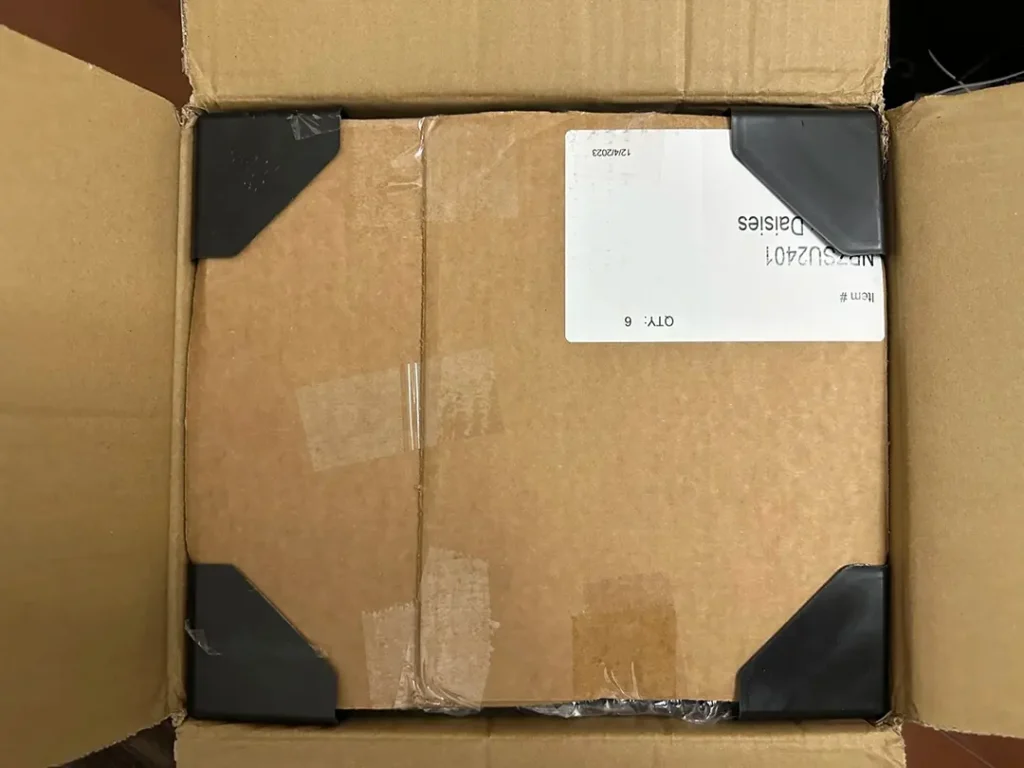
To lock packaging quality without endless back-and-forth, ask for these before mass shipment:
- Packaging photos (open carton + inner supports + lens protection close-ups)
- Carton label sample showing Model / Side / Rev / Batch
- Carton spec (board grade and dimensions)
- Drop/handling statement (even a basic internal standard is better than “we pack well”)
- Palletization method (if shipping palletized): wrap, corner boards, stacking height
- Moisture plan for your region (desiccant, bagging, storage notes)
If you only enforce one thing: enforce label fields + inner immobilization. Those two prevent the biggest category of avoidable pain.
Closing: Export packaging is not a cost—it’s a claims strategy
Pour aftermarket projector headlights, export packaging is where product quality meets supply chain reality. A strong optical design won’t protect you from a broken tab. A clean beam pattern won’t survive a warehouse drop if the lamp can move inside the carton. And no warranty policy feels fair when evidence is messy.
A packaging standard that is repeatable, testable, and traceable does three things for a B2B program:
- reduces damage rate in transit
- speeds up claims resolution with clear evidence
- keeps reorders boring—in the best way
That’s the goal: fewer surprises, fewer arguments, and more cartons that arrive ready to sell.



 English
  Spanish
  Vietnamese
  Thai
Thai  Arabic
  Russian
  Malay
Malay  French
  German
  Hindi
Hindi