
People buy projecteurs pour voitures expecting “more light.” What they don’t expect is the boring part: a month later one side flickers, the bracket loosens, the beam slowly drifts upward, or the radio starts hissing like it’s mad at you.
That’s not a reason to skip Projecteurs LED pour voitures—it’s just what happens when you bolt powerful electronics onto a vehicle that lives in heat, rain, vibration, mud, and pressure washing. This guide is for the ownership phase: keeping your lights dependable, legal-ish in daily use, and not a weekend project that never ends.
Car Spotlights After the Install: What “Good” Looks Like at 30 Days, 6 Months, 1 Year
If your setup is healthy, you’ll notice these patterns over time:
- No aim drift: the beam lands in the same place week after week.
- Stable output: brightness doesn’t fade after 10–20 minutes of driving.
- Pas de scintillement au ralenti: engine RPM changes don’t affect the light.
- No condensation: the housing stays clear after rain or washing.
- No new noises: no buzzing from drivers, no radio interference.
If any of those start slipping, you don’t need a new product page—you need a diagnosis.
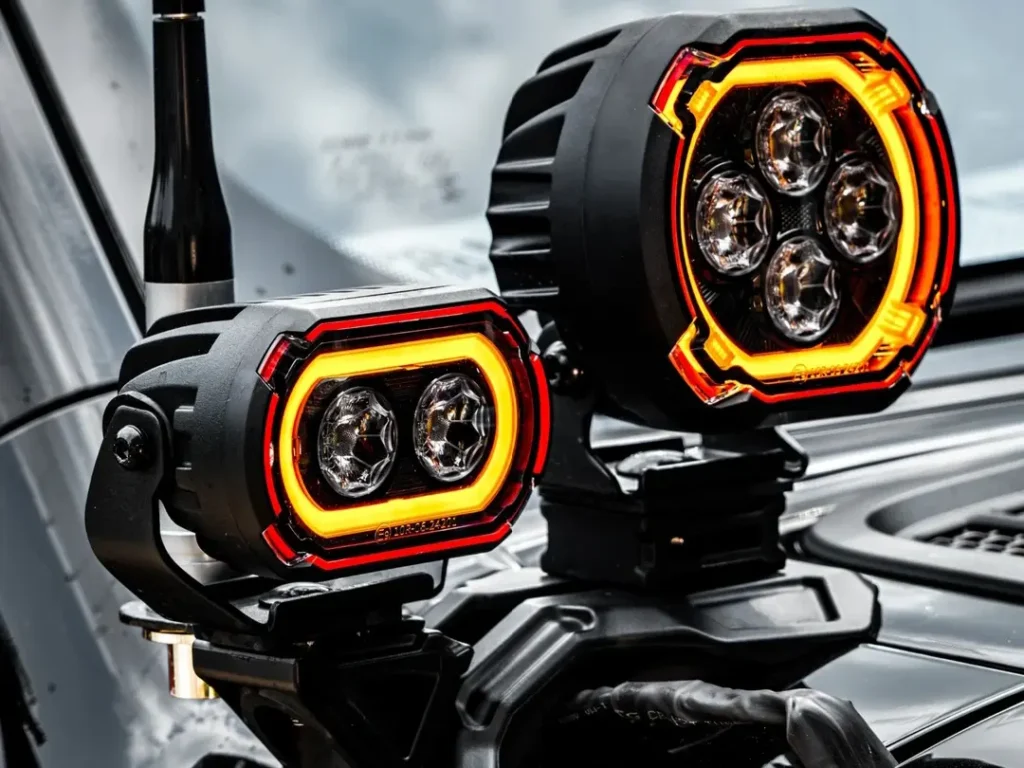
LED Car Spotlights Maintenance Routine (5 Minutes a Month, Saves Hours Later)
This is the “set and forget” routine that actually makes setups stay set-and-forget.
Monthly 5-minute check
Do this with the lights off, engine cool:
- Bracket hardware: confirm bolts are tight; look for shiny wear marks (a sign of movement).
- Wire routing: check for rubbing on metal edges, sharp corners, or moving parts.
- Connectors: tug lightly—if a plug moves, it will eventually fail.
- Ground point: make sure it’s clean and not growing corrosion.
- Aim sanity check: if the beam seems higher than you remember, it probably is.
After heavy rain, mud, or pressure washing
- Rechercher fogging/condensation inside the lens.
- Check for water in connectors (green/white crust is the warning sign).
- Confirm the lights still turn on every time (intermittent is always “on its way to dead”).
LED Car Spotlights Troubleshooting: Symptoms, Causes, and Fast Fix Paths
This section is the difference between “I think my light is defective” and “oh…it was one dirty ground.”
Symptom 1: Flicker at idle or when you hit bumps
This usually points to voltage drop or a bad connection, not the LEDs themselves.
Common causes
- Weak or painted ground point
- Loose crimp terminal / cheap connector
- Thin wire for the load
- Relay socket pins not seated fully
Fast fix path
- Inspect and redo the sol first (clean metal-to-metal contact).
- Check all crimps: if you can rotate the wire in the terminal, it’s not crimped properly.
- Inspect the relay/socket; reseat or replace if it feels sloppy.
- If flicker correlates with bumps: look for a wire that’s been pinched or rubbed.
Symptom 2: One light is dimmer than the other
If one side is consistently weaker, it’s often uneven power delivery.
Common causes
- Corrosion inside one connector
- One side has a worse ground
- Voltage drop on a longer wire run
Fast fix path
- Swap the lights left-to-right.
- If the dimness follows the light → the light/driver may be the issue.
- If it stays on the same side → wiring/ground on that side.
- Open/inspect that side’s connectors for oxidation and moisture.
- Re-check ground point quality on the dim side.
Symptom 3: Bright at first, then noticeably dims after 10–20 minutes
That behavior is classic thermal protection (heat management), especially on compact housings.
Common causes
- Poor heat dissipation design
- Mounting location traps heat / blocks airflow
- Driver overheating
Fast fix path
- Make sure the rear heatsink area isn’t buried behind a plate or shoved against something.
- If the light always dims at roughly the same time every drive, the product may be thermally limited—no wiring fix will change physics.
Symptom 4: Radio noise, buzzing, or interference
This tends to come from driver electronics and poor filtering, and it gets worse with messy grounding.
Common causes
- Low-quality driver without EMI suppression
- Grounding issues
- Power wiring routed near antenna/audio wiring
Fast fix path
- Improve the grounding (again—boring, but effective).
- Re-route the power lines away from sensitive wiring where possible.
- If it’s still bad, you may need suppression components or a different driver design.
Symptom 5: Condensation inside the housing
A little fog that clears quickly can happen with temperature swings. Persistent moisture is a problem.
Common causes
- Seal compromised
- Breather/vent design ineffective or clogged
- Pressure washing forced water past seals
Fast fix path
- Check for cracks, loose bezel screws, damaged gasket surfaces.
- Avoid blasting seals directly with a pressure washer.
- If it never clears, water is entering or not venting—long-term it will corrode internals.
“My Lights Keep Losing Aim”: The Real Reasons (It’s Usually Not the Lamp)
Aim drift is one of the most common complaints with projecteurs pour voitures, especially on rough roads.
Typical causes
- Bracket flex (thin metal, long lever arm, tall mounts)
- Hardware loosening (no locking hardware, vibration)
- Mounting surface flexing (thin bumper plastics vs rigid bar)
Practical fixes
- Upgrade to a more rigid bracket or reinforce the mount point.
- Use proper locking hardware (nyloc nuts / threadlocker where appropriate).
- Shorten the lever arm: mounting closer to a rigid structure helps.
Aim drift is a small problem at the start—and a constant annoyance later if ignored.
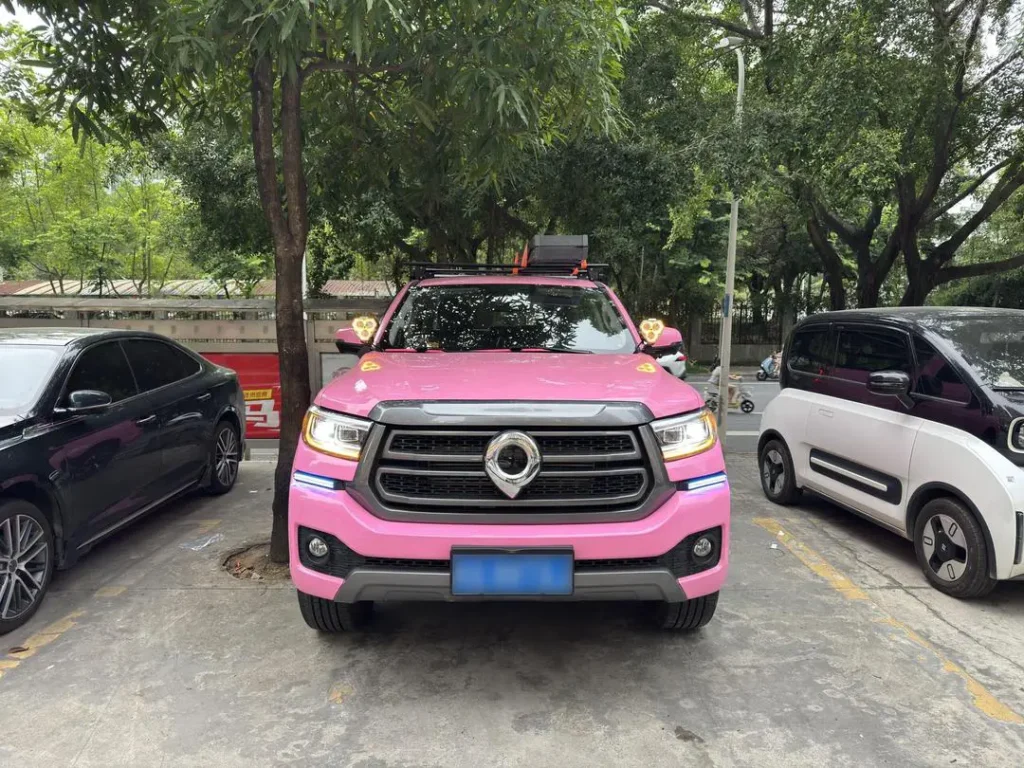
Using LED Car Spotlights in Daily Driving (Without Creating Glare Drama)
You don’t need a lecture here—just the rule that prevents 90% of conflict:
- If there are oncoming headlights, dip early.
- If you’re behind a vehicle, don’t light up their mirrors.
- In well-lit areas, auxiliary driving lights usually add more glare than value.
A setup that’s “too powerful to use” is the wrong setup in practice, even if it looks great in photos.
Quick Owner Checklist (Copy/Paste Friendly)
- Monthly: tighten brackets, check loom rub points, inspect connectors, verify aim.
- After storms/mud/wash: check condensation + connector corrosion.
- Scintillement: treat as a connection/ground issue first.
- Dimming after 10–20 min: suspect heat management.
- Radio noise: grounding + routing first, then consider suppression.
Final Takeaway: Reliability Is the Real Upgrade
Projecteurs LED pour voitures are easy to buy and fun to install. Keeping them reliable is what separates a clean build from a constant “why is it doing that?” mystery.
Most problems are small at the start. Catching them early keeps you from “chasing ghosts” later.
If you’re still choosing or installing lights, start with our complete spotlight installation guide.

 English
  Spanish
  Vietnamese
  Thai
Thai  Arabic
  Russian
  Malay
Malay  French
  German
  Hindi
Hindi