
Many drivers ask whether they can put LED bulbs in projector headlights. It is one of the most common questions in automotive lighting, especially as more vehicle owners look for brighter, whiter, and more energy-efficient lighting solutions. At the same time, people also want to know how long projector bulbs last and whether 4200K or 6000K is the better color temperature.
The short answer is that yes, you can sometimes put LED bulbs in projector headlights, but compatibility matters a lot. Not every projector is designed for every bulb type, and a poor match can result in weak output, scattered light, hot spots, dark spots, or glare. To make the right decision, it is important to understand projector design, bulb lifespan, and color temperature performance.
Can you put LED bulbs in projector headlights?
Yes, LED bulbs can be used in some lampu depan proyektor, but whether they will perform well depends on the design of the projector and the LED bulb itself.
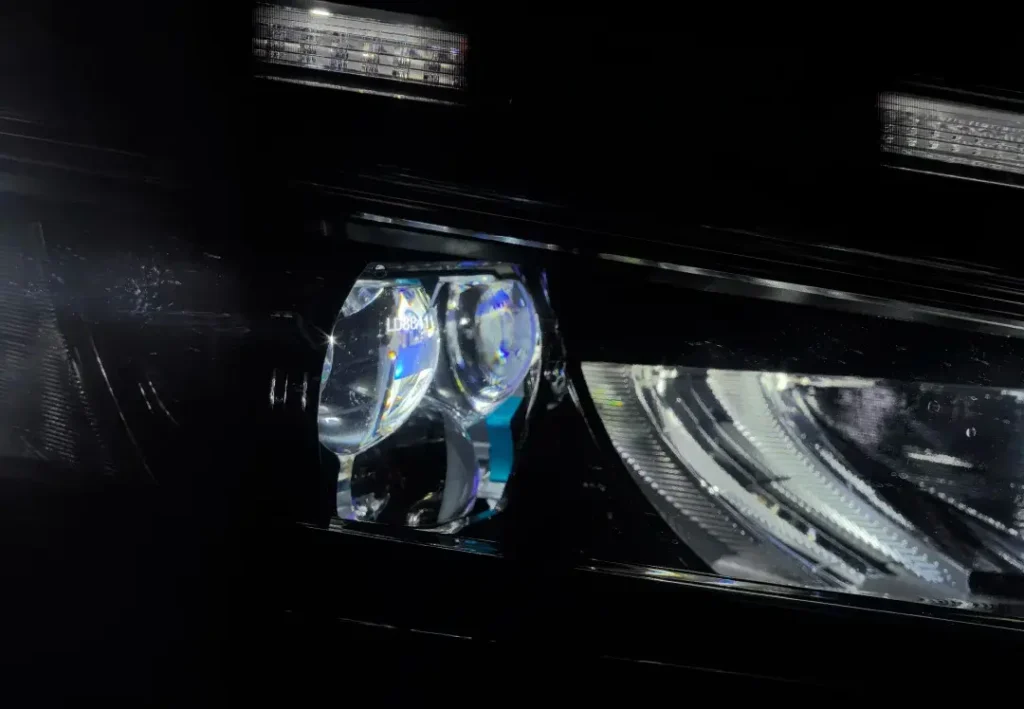
A projector headlight is an optical system built around a specific light source geometry. If the projector was designed for a halogen bulb, an LED replacement may not place light in exactly the same position as the original filament. This can change the beam pattern and reduce performance. If the projector was designed for LED from the beginning, the results are usually much better.
When LED bulbs can work well
LED bulbs may work well in projector headlights when:
- The projector is compatible with LED light source geometry
- The LED bulb is designed to mimic halogen filament placement
- The bulb is from a reputable manufacturer
- The heat management system works correctly
- The headlight is properly aimed after installation
When LED bulbs may not work well
LED bulbs may perform poorly when:
- The projector was engineered only for halogen output
- The LED chips are poorly positioned
- The bulb is too large for the housing
- Cooling fans or heat sinks create fitment issues
- The beam pattern becomes distorted
This is why simply installing a brighter bulb does not guarantee better lighting.
Why compatibility matters
The main issue is optical alignment. In a projector headlight, the light source must sit in the correct focal position so the reflector bowl, shield, and lens can shape the beam correctly. If the LED chips are not located where the original filament would be, the beam can become uneven.
A good LED conversion should preserve:
- Cutoff sharpness
- Beam width
- Distance illumination
- Side illumination
- Low glare
If those elements are compromised, the headlight may look bright up close but perform worse on the road.
How long do projector bulbs last?
Projector bulb lifespan depends on the bulb type, quality, operating conditions, and heat management.
Halogen projector bulbs
Halogen bulbs typically last around:
- 450 to 1,000 hours for many standard bulbs
- Less for high-performance halogen bulbs designed for maximum brightness
Performance halogen bulbs often burn brighter but wear out faster.
HID projector bulbs
HID bulbs often last around:
- 2,000 to 3,000 hours
- Sometimes longer depending on ballast quality and usage patterns
Over time, HID bulbs may lose brightness and shift in color before they fully fail.
LED projector systems
LED systems can last much longer, often:
- 10,000 hours or more in well-designed systems
- Sometimes significantly longer in OEM-grade sealed designs
However, LED lifespan depends heavily on thermal management. If an LED bulb runs too hot, its actual lifespan can drop quickly.
What affects projector bulb lifespan?
Several factors influence how long projector bulbs last:
1. Heat
Excessive heat is one of the biggest causes of reduced lifespan, especially for LEDs.
2. Electrical stability
Voltage fluctuations can shorten the life of halogen, HID, and LED systems.
3. Product quality
Cheaper bulbs often use lower-grade materials and less stable electronics.
4. Driving conditions
Frequent on and off cycling, vibration, dust, and moisture can all reduce lifespan.
5. Housing ventilation and sealing
Poorly sealed housings can allow moisture in, while poor ventilation can trap heat.
Is 4200K better than 6000K?
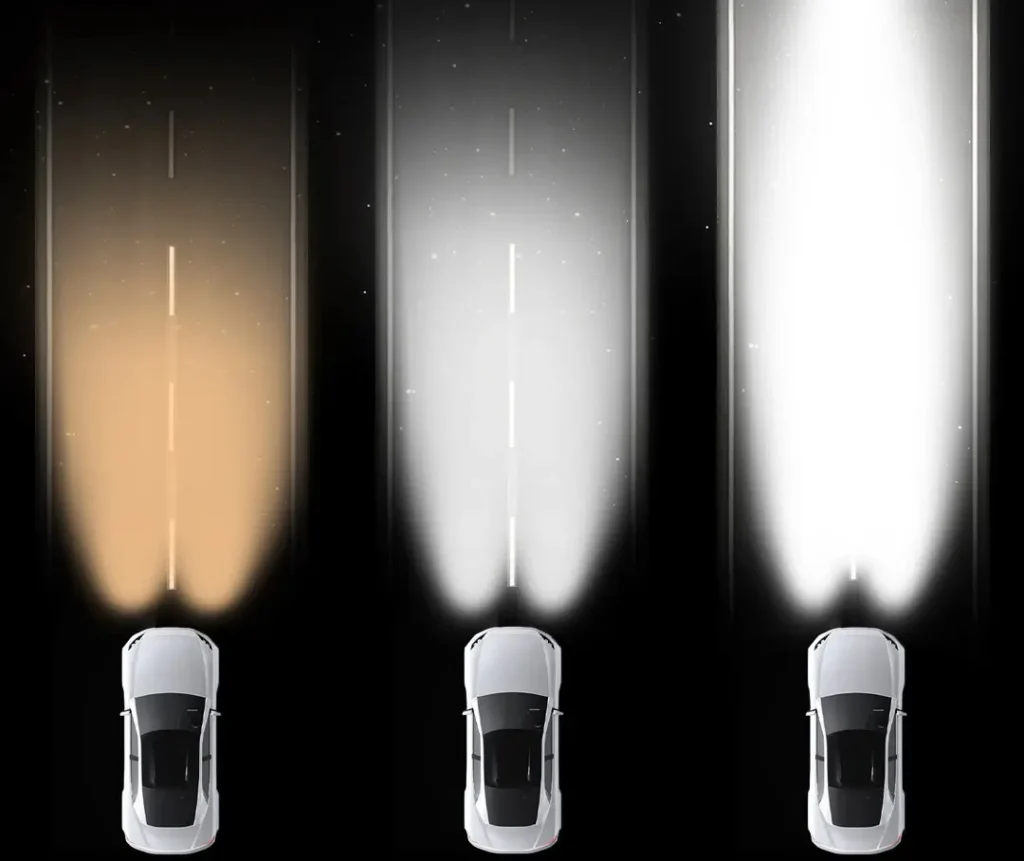
Whether 4200K is better than 6000K depends on your priorities. For practical road visibility, many drivers consider 4200K to be better. For appearance, some prefer 6000K because it looks whiter and more modern.
What 4200K looks like
4200K usually appears:
- Warm white to neutral white
- Slightly similar to OEM HID lighting
- Less blue in tone
This color temperature is often praised for balanced road visibility and all-weather usability.
What 6000K looks like
6000K usually appears:
- Cool white
- Slightly blue-white
- More modern or stylized in appearance
Many drivers like 6000K because it looks clean and premium, especially on modified vehicles.
4200K vs 6000K for visibility
For actual driving visibility, 4200K often has an advantage. It tends to provide a more natural contrast on the road and may perform better in rain, fog, or poor weather. Extremely cool light can create more glare and can reflect more harshly off wet surfaces.
4200K is often preferred for:
- Daily driving
- Long-distance road use
- Balanced comfort and clarity
- Better foul-weather usability
6000K is often preferred for:
- Modern styling
- Show builds
- Drivers who prioritize visual appearance
- Vehicles with a custom aesthetic focus
Which color temperature should you choose?
Choose 4200K if you want:
- Better practical visibility
- A more OEM-style output
- Better performance in mixed weather conditions
- Less blue tint
Choose 6000K if you want:
- A cooler white appearance
- A more customized or modern look
- A stronger style statement
For many drivers, the best answer is to choose the color temperature that balances road performance and appearance rather than chasing the coolest-looking light.
Best practices for LED bulbs in projector headlights
If you are planning to install LED bulbs in projector headlights, follow these guidelines:
- Check whether the projector was designed for halogen, HID, or LED
- Choose bulbs with accurate emitter placement
- Avoid very cheap no-name products
- Confirm housing fitment and cooling clearance
- Aim the headlights after installation
- Test beam pattern on a wall and on the road
- Watch for dark spots, scattered light, or excessive glare
A successful upgrade is about optical quality, not just brightness claims.
Final thoughts
Yes, LED bulbs can be used in some projector headlights, but the results depend on compatibility, product quality, and correct installation. A good LED setup can provide efficient, modern lighting with long service life. A bad one can reduce beam quality and create glare.
Projector bulb lifespan varies by technology, with halogen being the shortest-lived, HID offering moderate longevity, and well-designed LED systems potentially lasting the longest. As for color temperature, 4200K is usually better for practical visibility, while 6000K is often chosen for its cleaner, cooler appearance.
If your goal is real driving performance, choose a setup that preserves beam pattern and road visibility first. If your goal is style, make sure appearance does not come at the expense of safety.
 English
  Español
  Tiếng Việt
  ไทย
ไทย  العربية
  Русский
  Bahasa Melayu
  Français
  Deutsch
  हिन्दी
  Bahasa Indonesia