
If you’ve ever followed a car in thick mist and noticed one angry red lamp burning on a single side, you’ve probably had the same thought most drivers have:
“That can’t be right.”
It looks like a fault because we’re trained to expect symmetry at the rear of a vehicle—two tail lamps, two brake lamps, two reverse lights, everything balanced and mirrored. So when only one rear fog lamp is blazing, your brain flags it as “broken” before it even considers “intentional.”
On many cars, it is intentional.
Rear lampu kabut aren’t there to look good and they aren’t there to light the road. They’re a communication device—more like a flare than a bulb. And communication design has one brutal rule: in bad conditions, anything ambiguous gets misunderstood.
This article isn’t about etiquette or “when to turn rear fogs on.” That usage discussion lives elsewhere. If you’re here for the “when to use it (and when to turn it off)” side of rear fog lights, that’s in my Rear Fog Light Etiquette piece.
Here, we’re staying on the design logic: why a single rear fog lamp can be clearer (and sometimes safer) than a perfectly symmetrical pair.
Rear Lampu Kabut Are a Signal, Not an Illumination Tool
A rear fog lamp exists for one reason: to make your vehicle recognizable from behind when visibility collapses—fog, heavy road spray, blowing snow, dust.
In those conditions, the driver behind you is short on everything:
- contrast
- distance cues
- time to react
- mental bandwidth
People love to imagine drivers calmly processing information like a pilot in a simulator. Real fog driving is messier. It’s pattern recognition under stress: “Is that a car? How far? Closing fast or not?”
Rear fog lamps are designed to win that recognition battle.
The Real Engineering Problem: Rear Fog Lamps Live Next Door to Brake Lamps
Here’s the uncomfortable truth designers have to respect:
- Rear fog lamps are bright red
- Brake lamps are bright red
- In fog/spray, light blooms and reflections smear
- Drivers rely on quick pattern cues, not careful analysis
If a rear fog lamp visually blends with a brake-lamp pattern, it can create hesitation: “Are they braking or just… bright?” In low visibility, hesitation is expensive.
That’s why “make it brighter” is not the whole solution. Designers also need “make it unmistakable.”
Why “One Rear Fog Light Only” Can Reduce Brake-Light Confusion
Symmetry is friendly on a clear day. In fog, symmetry can be misleading.
Two intense rear fog lamps can resemble a “braking-ish” state at a distance, especially when you factor in:
- wet asphalt reflecting red light into a long smear
- spray turning a crisp lamp into a fuzzy glow
- the driver behind scanning through visual noise (wipers, droplets, glare)
A single rear fog lamp creates an asymmetric signature—a pattern that does tidak match normal tail lamp symmetry and does tidak match the usual brake lamp symmetry.
That asymmetry works like a label: “This is a special state.” It’s intentionally a little weird-looking so the brain doesn’t file it under the wrong category.
Think of it this way: a rear fog lamp isn’t trying to look “normal but brighter.” It’s trying to look “different on purpose.”

Why One Bright Point Can Punch Through Fog Better Than Two Balanced Ones
Fog compresses the scene. Your visual world gets flattened into fewer layers:
- “near” and “far” feel closer together
- silhouettes fade
- lane markings blink in and out
- everything becomes the same gray family
In that environment, designers often prefer a single, high-salience marker over multiple sources that might blend into the general “rear light signature.”
One bright lamp on one side becomes a reference point: “There is a vehicle ahead, in that lane space.” It’s easier to lock onto.
This is also why some drivers interpret it as “something is wrong.” They’re correct in one sense: it’s not normal lighting. It’s an abnormal-condition signal—designed to be conspicuous precisely because it’s not part of the everyday pattern.
Placement: Why It’s Often One Side, and Why That Side Varies
Drivers often ask: “Why is it on the left?” or “Why is it on the right?” The frustrating answer is: it depends—on market rules, conventions, and platform decisions.
Common real-world reasons include:
- Driver-side convention in many right-hand-traffic regions (and the opposite in left-hand-traffic regions)
- Packaging constraints inside the lamp (space, heat, shared optics)
- Platform standardization (one lamp design serving multiple markets)
- Distinctness from other functions (keeping fog separate from reverse/brake patterns)
The important point is that it’s rarely “random.” It’s usually a compromise among recognition, regulation, and manufacturing reality.
Regulations and Platform Strategy: Less Drama Than People Think (But Very Real)
Rear fog lamps are treated differently across regions:
- In some markets, rear fog lamps are common and expected.
- In others, many drivers have never used one and may not even know the symbol.
That creates a challenge for global car platforms: build one rear lamp architecture that can be sold widely, with different functions enabled or disabled depending on market requirements.
This is where you often see a “symmetry illusion”:
- the rear lamp housings look symmetric
- but only one side has the high-intensity rear fog function activated (or even physically populated)
From a manufacturer’s point of view, that approach can reduce:
- part-number chaos
- variant wiring complexity
- homologation combinations
- assembly mistakes
- warranty complaints due to misconfiguration
From a driver’s point of view, it can look like a missing bulb.
Both perspectives are rational. The mismatch is expectation.
The Lamp Architecture Trick: Shared Housings, Different Functions
A lot of “why is only one side on?” cases come down to how modern rear lamps are built.
Modern tail lamps are frequently multi-function modules where one physical area can be configured as:
- rear fog (high intensity)
- tail light (lower intensity)
- brake light (higher intensity)
- or sometimes a market-dependent combination
In some designs, the opposite side may contain:
- a reverse lamp module
- a rear fog module
- or simply a different internal optic arrangement
So yes—two lenses can look similar on the outside while doing different jobs inside. That’s not necessarily cheapness; it’s often a packaging and regulation compromise.
Why LEDs Make the “One Rear Fog” Choice More Attractive
LEDs changed rear lighting in two big ways:
- They make high intensity easy.
- They make glare and reflection easy, too.
A rear fog lamp needs to be bright enough to cut through fog/spray. LEDs can deliver that cleanly. But because LEDs can be intense point sources, doubling them (two rear fog lamps instead of one) can increase:
- rearward glare in mild mist
- mirror discomfort in close following traffic
- wet-road red smear that competes with brake signals
- the chance that drivers misinterpret the overall rear signature
So “one rear fog lamp” can be a way to hit visibility targets without turning the rear of the car into an overly aggressive red billboard.
This is also why you’ll see rear fog decisions discussed in the same breath as broader LED fog lights for cars conversations: LED isn’t just a “front fog upgrade trend.” It’s the default technology shaping how signals behave across the entire vehicle.
Human Factors: How People Actually Interpret Rear Lights in Low Visibility
Designers spend a lot of effort on how drivers feel what they see.
In low visibility:
- Drivers notice changes more than absolute states.
- They categorize patterns fast: “normal tail,” “braking,” “hazard,” “weird.”
- They’re more likely to misread signals when multiple lights bloom into similar shapes.
A single rear fog lamp helps by being categorically “weird” in a consistent way—distinct from both normal tail lighting and typical braking patterns.
This isn’t about making the car prettier. It’s about reducing “Wait—what am I looking at?” moments.
Common Misunderstandings (and Why They Persist)
“Only one rear fog light means the other is burnt out.”
Sometimes true. Often not.
Because rear fog lamps are uncommon in some regions, many drivers assume symmetry must apply. But rear fog lamps are not brake lamps. They’re a special function and may be implemented asymmetrically by design.
“It’s a cost-cutting move.”
Sometimes cost is part of any decision. But the more interesting driver is risk management:
- fewer variants
- fewer misinterpretations
- less chance of a dual-lamp signature being confused with braking
- less aggressive glare with LED intensity
“Cost” is an easy story. “Signal clarity across markets” is the real one.
“If it’s asymmetric, it’s unsafe.”
Not necessarily. In signaling, asymmetry can be a feature when it increases recognizability.
A Simple, Non-Etiquette “Is This Normal?” Check (Without Turning Into Troubleshooting)
This isn’t a repair guide, but here’s a quick way to avoid chasing a non-problem:
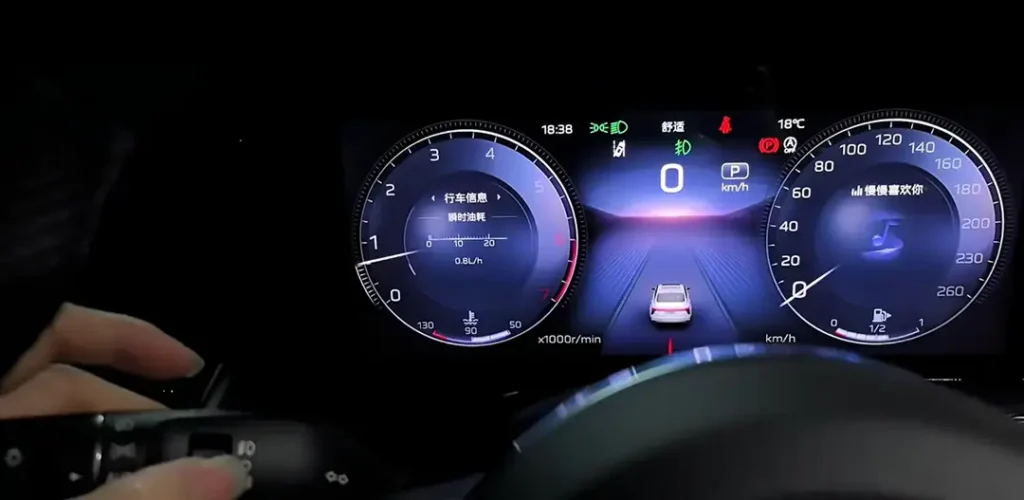
- Look for a rear fog symbol on the dashboard when it’s on.
- Check the owner’s manual section for rear fog lamp behavior (many manuals explicitly note “one side only”).
- Compare with the lamp layout: sometimes the opposite side is the reverse lamp, which is a clue that functions are split.
The goal here isn’t “how to use it.” It’s simply to recognize that “one lamp only” is often a documented design choice.
What the One-Sided Rear Fog Lamp Reveals About Modern Vehicle Lighting
Zoom out and the single rear fog lamp is a small example of modern lighting philosophy:
- Lighting is increasingly communication engineering, not just illumination.
- Designers care about misinterpretation risk, not just brightness.
- Platforms prioritize global consistency dan variant control.
- LEDs raise both the ceiling (better visibility) and the stakes (more glare if misused or overbuilt).
So when you see one rear fog lamp blazing through fog, you’re seeing a decision that’s less about symmetry and more about signal hierarchy: “This is the special warning marker—make it noticeable, make it distinct, don’t let it look like braking.”
Takeaway: One Rear Fog Light Is Often a “Make This State Unmistakable” Decision
Rear fog lamps are meant to be rare, high-impact signals for ugly visibility. Two lamps can be brighter, but brightness isn’t the only goal—and in some conditions it isn’t even the best one.
A single rear lampu kabut unit can:
- reduce brake-light confusion
- create a distinct, categorizable signature
- meet conspicuity needs without doubling glare
- simplify cross-market platform implementation
It may look unbalanced in a showroom. In fog, it can look like exactly what it is: a deliberate marker designed for stressed human perception, where clarity beats symmetry.

 English
  Español
  Tiếng Việt
  ไทย
ไทย  العربية
  Русский
  Bahasa Melayu
  Français
  Deutsch
  हिन्दी
  Bahasa Indonesia