
The first time you drive into real fog, it doesn’t feel dramatic at the start. It feels… quiet. The horizon shrinks. Road signs arrive late. Tail lights ahead turn into two faint red dots that could vanish at any moment. Your instincts tell you to “see more,” so your hand reaches for brighter lights—often the exact wrong move.
This guide is a practical, human one: what противотуманные фары are, where they are, how to turn them on, and—most importantly—when fog lamps should be used so they actually protect you instead of blinding everyone else.
What fog lights actually do (and why they feel different from headlights)
Fog isn’t just “air that’s hard to see through.” It’s thousands of tiny water droplets suspended in front of you, bouncing light back toward your eyes. That’s why fog can make a road look like a white wall.
Fog lights are designed to work with that physics instead of fighting it.
1) Better penetration (especially with selective yellow)
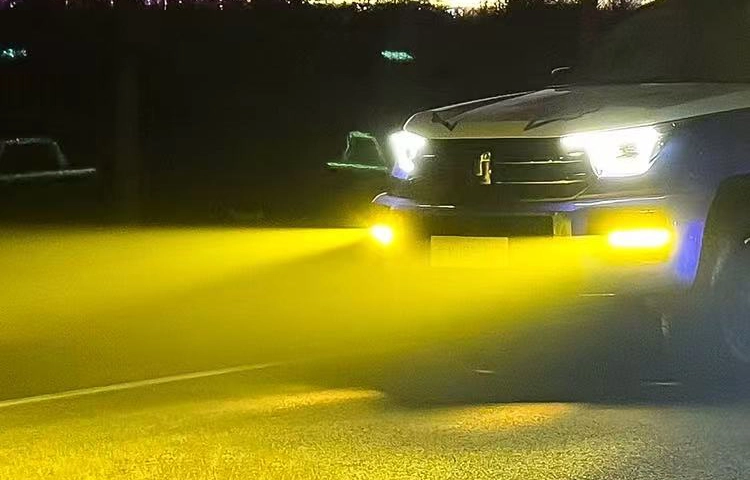
Many fog lights—especially traditional setups—use a warmer, yellower light. Longer wavelengths scatter a bit less in fog, rain, and snow, which can reduce glare and improve contrast.
Important nuance: modern white LED fog lights can still be effective if they’re well-designed, properly aimed, and used correctly. The magic is less about “yellow vs. white,” and more about beam shape + mounting position + aim.
2) Low, wide beam that hugs the road
Fog lights are mounted lower than headlights and aim downward, illuminating the lane markings and road edges close in front of the car. That low angle reduces the “light bouncing straight back into your eyes” effect.
3) Rear fog lights that cut through the gray
Rear fog lights are brighter than normal tail lights. In dense fog, they help drivers behind you realize you’re there до it becomes a surprise.
They’re not for style. They’re for preventing the worst kind of crash: the one you never see coming.
fog lights car: Why “more light” is not always “more visibility”
This is where many good drivers make an honest mistake. When visibility drops, your brain wants maximum brightness. But fog punishes bright, upward-aimed beams.
The high-beam trap
High beams throw light higher and farther—perfect on a clear night. In fog, that light reflects off droplets and creates a bright haze right in front of you, shrinking your usable vision.
If you’ve ever said, “I turned on my high beams and it got worse,” that wasn’t your imagination. That was physics being rude.
What a safe lighting combo usually looks like
In fog (depending on local laws and your vehicle):
- Low beams: almost always yes
- Противотуманные фары: yes, when visibility is genuinely reduced
- Parking/position lights (marker lights): helpful for being seen
- Hazard lights: only when you’re moving extremely slowly, stopped, or traffic conditions require it (rules vary by country)
And generally:
- High beams: no
- Rear fog light: yes in dense fog, but turn it off when visibility improves to avoid blinding drivers behind you
what is fog lamp: Spotting them on your vehicle (and on the dashboard)
A fog lamp is a dedicated light designed for reduced-visibility conditions—fog, heavy rain, snow, dust—built to minimize glare and maximize near-road guidance.
Where you’ll see them on the car
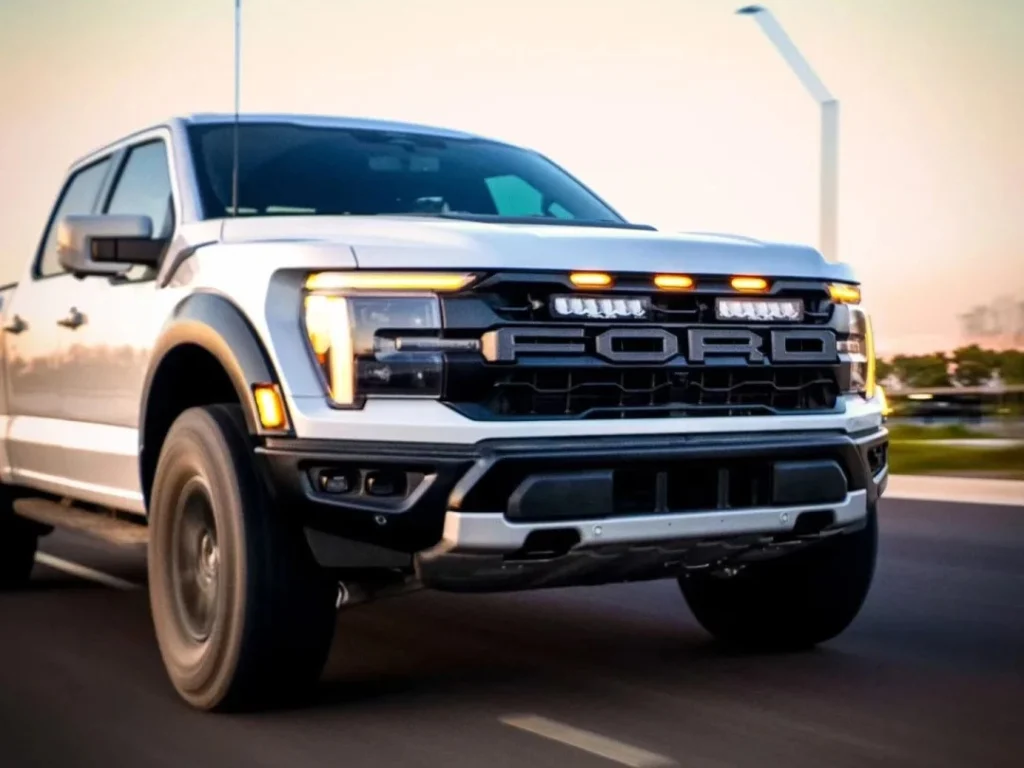
- Front fog lamps are often mounted low in the front bumper (left/right).
- Rear fog lamp may be on one side only (common on many European designs), or both sides depending on the vehicle.
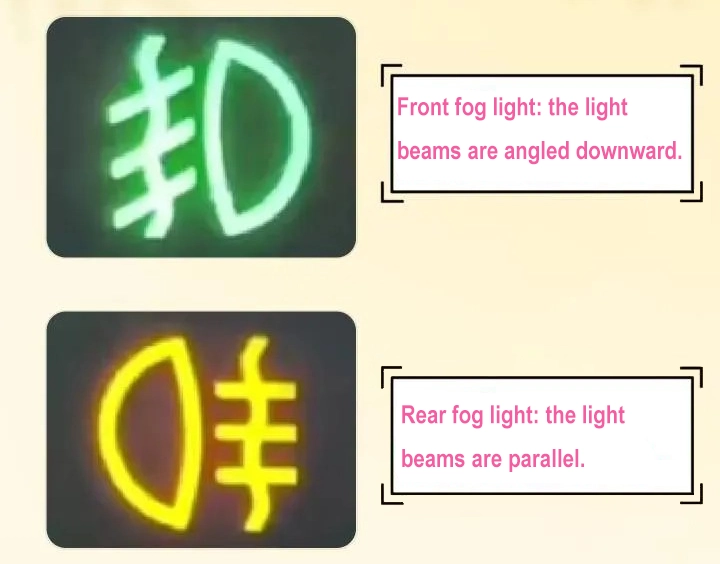
How to recognize the dashboard symbols (quick visual logic)
While icons vary by manufacturer, a common pattern is:
- Front fog light symbol: beams pointing down with the lamp facing left
- Rear fog light symbol: beams with the lamp facing right (often amber/yellow indicator on the dash)
If you remember nothing else: front fog = helps you see the road edge; rear fog = helps others see you.
fog lamp switch: Where it is and how to turn fog lights on (3 common setups)
Fog lights are famous for hiding behind menus, rings, and “one more click.” Here are the most common control styles.
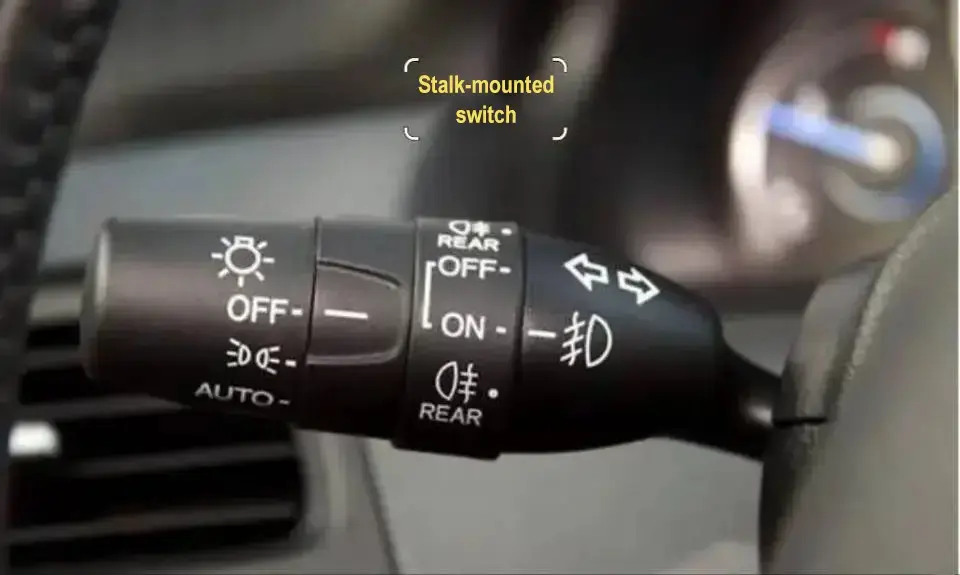
1) Stalk ring (twist-to-activate)
Often on the turn-signal or headlight stalk.
Typical steps:
- Turn off AUTO headlights (on some cars, fog lights won’t engage in AUTO).
- Switch to ближний свет if required.
- Twist the fog-light ring once for front fog.
- Twist again for rear fog (if equipped).
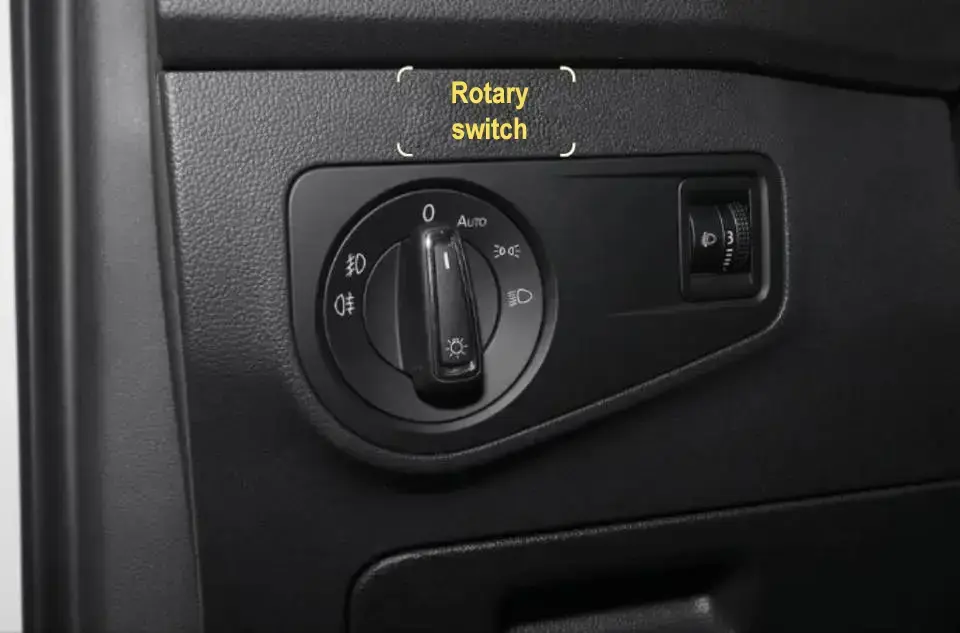
2) Pull-out headlight knob (push/pull control)
Common on some European vehicles.
Typical steps:
- Turn off AUTO mode if needed.
- Включить ближний свет if required.
- Pull the knob to the first stop: front fog.
- Pull to the second stop: rear fog.
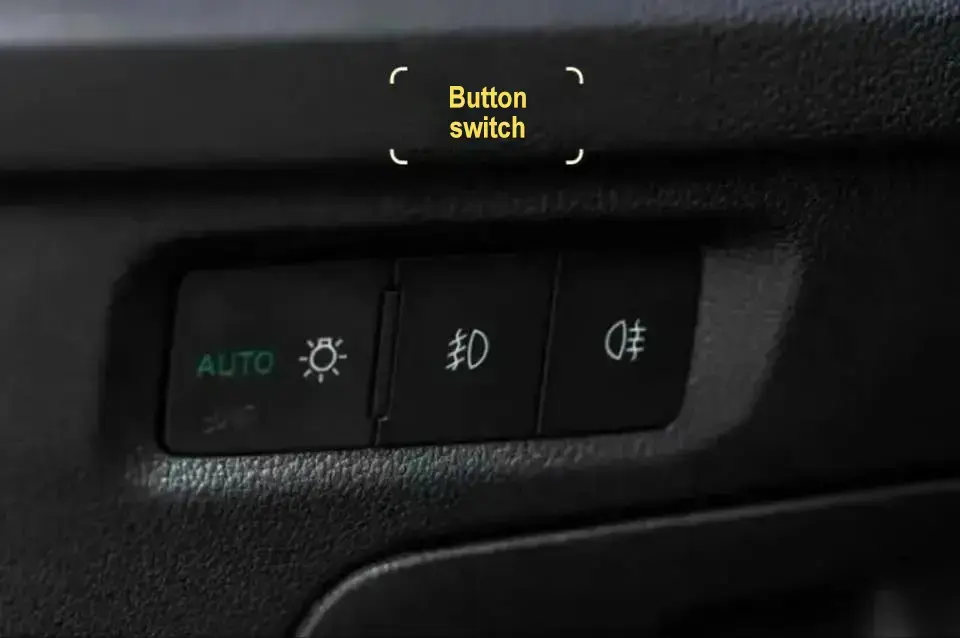
3) Dedicated button (physical or touchscreen)
Some cars use a button on the dash or in a screen menu.
Typical steps:
- Press the front fog button to enable.
- Rear fog may require front fog to be on first.
- Some vehicles require low beams first.
Two “gotchas” that confuse drivers everywhere
- Some cars won’t allow fog lights with DRLs only—you must turn on low beams.
- Some cars won’t allow rear fog unless front fog is already on.
If your fog light indicator never appears on the cluster, it’s usually one of those two.
front fog lamp: When it helps, when it doesn’t, and how to use it well
Front fog lamps shine low and wide—great for lane lines, curbs, and near-field guidance.
Use the front fog lamp when:
- Fog reduces visibility enough that you’re “driving by memory” more than sight
- Heavy rain is bouncing light back at you
- Snowfall is thick and headlights are creating glare
- Dust/smoke creates a low-contrast “gray curtain”
Don’t use the front fog lamp when:
- It’s clear and dry (it can create unnecessary glare and distraction)
- You’re trying to “reach farther” at highway speed (fog lamps are not distance lights)
Aiming matters more than people think
Mis-aimed fog lights can be worse than useless: they can glare into other drivers’ eyes through fog, rain, or mirrors.
If your fog lights seem to “light up the fog” instead of the road, they may be aimed too high—or you may be using them when low beams alone are better.
rear fog lamp: The lifesaver that can also be a jerk (if left on)
Rear fog lights are bright, and that brightness is the point. In dense fog, your normal tail lights can fade into the background. A rear fog lamp is a clear “I am here” signal.
Use the rear fog lamp when:
- Visibility is severely reduced (many regions use “under 50–100 meters” as a rule of thumb)
- Cars behind you are appearing suddenly, too close for comfort
- You’re on fast roads where closing speeds are high
Turn it off when:
- Visibility improves
- Traffic is dense and close behind you (because it becomes painful glare)
A rear fog light left on in clear weather is like shouting in someone’s ear because you forgot you were holding a megaphone.
fog lamps should be used: Two stories that make the point (without preaching)
Fog safety advice can sound repetitive—until you attach it to real moments. Here are two true-to-life scenarios (details anonymized and dramatized for clarity).
Case 1: “I thought high beams would help”
It was early autumn, the kind of morning that looks harmless from a window. A commuter left home before sunrise and hit a low valley road where fog settles like spilled milk.
Visibility dropped fast. The driver did what many people do: turned on high beams.
Instead of seeing farther, the road became a bright blur. The driver slowed, but not enough—because speed feels different when the world shrinks. A gentle curve arrived too late. The car drifted wide, tires touched the edge line, then the shoulder. A quick correction followed—panic-fast—and the car snapped back toward the lane.
No rollover. No headline. But the car clipped a reflector post and spun into a shallow ditch.
The driver was fine, shaken and embarrassed more than injured. The tow truck driver said something simple that stuck: “Fog isn’t darkness. It’s a mirror.”
What would have helped:
- Low beams + front fog lights
- Slower speed earlier (before the “surprise fog wall”)
- Following lane markings, not the glow ahead
- No high beams
Case 2: The rear fog light that prevented the second crash
On a multi-lane highway, fog rolled in unevenly—clear patches, then sudden blindness. A family car ahead had a minor mechanical issue and pulled onto the shoulder. They did the right things: hazards, triangle, moved away from the vehicle.
But what changed everything was the rear fog lamp on a car that had slowed in the right lane before the shoulder—bright red, unmistakable through the gray. Drivers behind saw that red point early and started braking sooner. The chain reaction still happened—hard braking, a couple of close calls—but it didn’t become a pile-up.
Sometimes safety isn’t a heroic maneuver. Sometimes it’s one light used correctly, early, in time for other people’s brains to catch up.
That’s the emotional truth of fog: it steals reaction time. Fog lights give some of it back.
Practical fog driving rules that actually work (not just “be careful”)
Good fog driving is mostly boring decisions made early.
1) Slow down and increase following distance
- Reduce speed до you feel uncomfortable.
- Increase gap to the vehicle ahead. In fog, your “normal” distance is suddenly too short.
If you’re on a highway, follow local guidance and variable speed limits. Fog is one of the few conditions where the safest driver in the group is often the slowest one—as long as they’re predictable.
2) Use the right lights (and avoid the wrong ones)
In foggy conditions:
- Используйте ближний свет
- Используйте передние противотуманные фары when visibility is reduced
- Используйте rear fog light only in dense fog, then turn it off when conditions improve
- Avoid дальний свет
3) No sudden braking, no impulsive lane changes
Fog distorts distance. New drivers especially can misjudge closing speed.
- Brake early and gently when possible
- Avoid “threading the needle” through lanes
- If you must change lanes, do it slowly and signal longer than usual
4) Watch your mirrors as much as the road ahead
In fog, the danger isn’t only what you can’t see in front—it’s what’s coming behind you, too fast.
If traffic compresses suddenly:
- Tap brakes lightly to flash brake lights
- Use hazards if you’re moving very slowly or stopped (check your local rules)
5) Choose lanes with escape space
A simple positioning habit can help:
- On three-lane roads, the middle lane often offers the most options.
- On two-lane roads, avoid driving side-by-side with another vehicle—stagger positions.
6) If there’s an accident or breakdown: get out of the “target zone”
Secondary crashes are common in fog.
If your car can move:
- Get to a safer place (shoulder, exit, emergency bay)
If it cannot:
- Hazards on
- Place warning triangle at the recommended distance (varies by country; highways often require farther)
- Move people away from the vehicle and traffic
- Call emergency services
A memorable rule many safety agencies use: “Vehicle to the side, people away, call for help.”
Rain + fog: The extra challenges people underestimate
Fog plus rain is a special kind of difficult: reduced visibility, low traction, and a windshield that wants to fog up from the inside.
1) Quick pre-drive checks (takes 2 minutes, saves a lot)
- Tires: worn tread increases hydroplaning risk
- Wipers: streaking wipers turn fog into a smudge painting
- Washer fluid: road film + fog is brutal
- Headlights/taillights: make sure they’re clean and working
2) Watch for hydroplaning (“water skating”)
On wet roads at higher speeds, tires can ride on a thin water layer.
To reduce risk:
- Slow down
- Avoid hard steering inputs
- Avoid heavy braking on standing water
3) Prevent the inside of the windshield from fogging
When outside is damp and inside is warm, your glass becomes a condensation magnet.
What helps:
- Используйте A/C (it dehumidifies)
- Set airflow to windshield defog/defrost mode
- Use fresh air intake if cabin humidity is high
What doesn’t help (and is risky):
- Wiping the windshield while driving
A simple “Fog Light Routine” you can memorize
When visibility drops and stress rises, routines beat improvisation:
- Low beams on
- Front fog lights on (if visibility reduced)
- Rear fog light on (only if dense fog and you need to be seen)
- Speed down, distance up
- No high beams
- Stay predictable (smooth inputs, early signals)
If you practice finding your fog lamp switch once when parked—today—you’ll thank yourself the first time fog shows up unexpectedly. Because in that moment, you won’t be hunting through menus. You’ll be driving.
Takeaways you’ll remember on a foggy morning
Fog doesn’t just hide hazards—it makes you feel falsely confident right up until it doesn’t. Used correctly, противотуманные фары are less about “seeing farther” and more about seeing smarter: near-road guidance up front, and unmistakable presence in the rear.
- Front fog lamp: low + wide = better lane-edge visibility
- Rear fog lamp: powerful red warning = prevents sudden close calls
- High beams in fog: usually make visibility worse
- The best safety upgrade is often not hardware—it’s the habit of using it correctly
 English
  Spanish
  Vietnamese
  Thai
Thai  Arabic
  Russian
  Malay
Malay  French
  German
  Hindi
Hindi